
Eliminating Waste, Mitigating AI Risk, and Driving Performance
A Strategic Guide for Procurement Managers, Aligned with TrinityP3 Methodology
Executive Summary
Introduction: The New Procurement Mandate: From Price Taker to Value Creator
The Four Pillars of Waste in Marketing Communications: A Diagnostic Framework
AI in Marketing Communications: Opportunity, Risk, and the New Frontier of Waste
The TrinityP3 P3 Framework: Architecting Value
Procurement’s Strategic Role: From Gatekeeper to Risk Mitigator
The Strategic Marketing Procurement Plan (SMAP): A Blueprint for Performance
Conclusion: The Future-Proofing Partner
1. Executive Summary
The role of Marketing Procurement is undergoing a fundamental and necessary transformation. For too long, the function has been confined to the narrow, often counterproductive, mandate of generating upfront cost savings (price reduction). This approach frequently forces agencies to cut corners, increase rework, and ultimately deliver sub-optimal creative output – the very definition of waste.
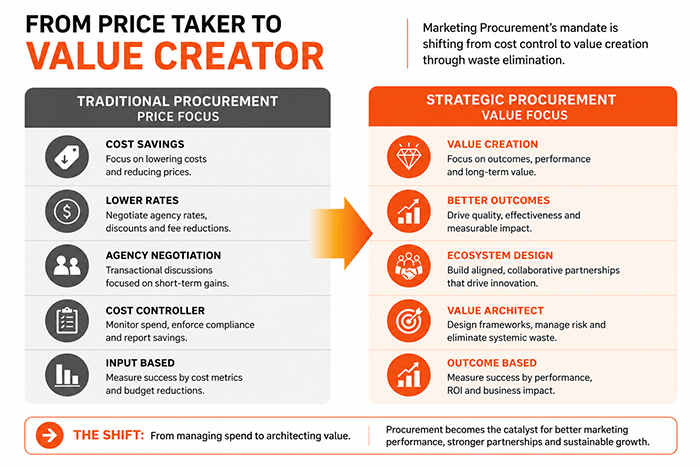
The modern, strategic mandate for the procurement professional is a pivot to Value Creation and Waste Elimination. True savings are not found in driving down hourly rates, but in establishing the structural, commercial, and operational frameworks that guarantee maximum marketing effectiveness. This means embracing a partnership role with marketing colleagues, focusing on the quality, efficiency, and impact of the expenditure, rather than simply the price of the input.
This paper details a rigorous framework for achieving this transition, fully aligned with the advisory principles and practice areas of TrinityP3. We will identify the four major categories of systemic waste, provide a blueprint for managing the unprecedented commercial and ethical risks introduced by Artificial Intelligence (AI), address the productivity opportunities within in-house agency functions, and present the Strategic Marketing Procurement Plan (SMAP). By mastering the principles of Purpose, People, and Process (P3), procurement managers can redefine their mandate, secure demonstrably greater value, and become the indispensable Value Architects necessary for resilient and high-performing marketing organisations.
2. Introduction: The New Procurement Mandate: From Price Taker to Value Creator
The Inadequacy of Cost-Cutting: The False Economy
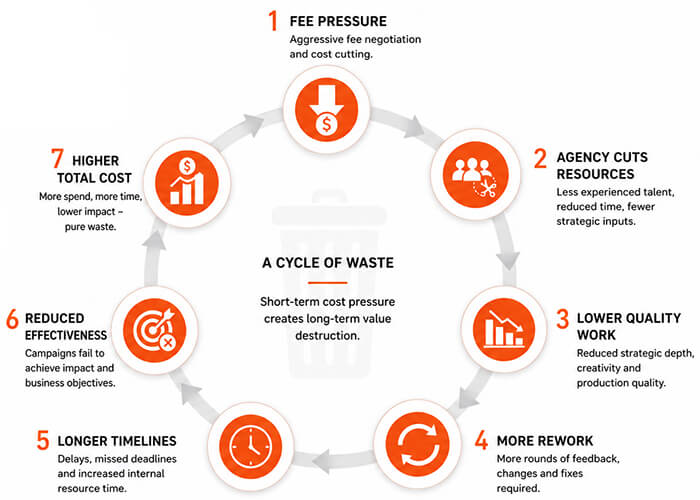
For decades, the standard Key Performance Indicator (KPI) for marketing procurement was a simple, easily quantifiable metric: savings achieved. This often involved aggressive negotiation of agency hourly rates, imposing steep discounts, or demanding across-the-board budget cuts. While these actions generate an immediate, positive blip on the finance report, they frequently prove to be a false economy.
When agency fees and margins are arbitrarily squeezed, the commercial ecosystem suffers. Agencies, as commercial businesses, must compensate. They are forced to reduce costs by using less experienced staff, reducing time dedicated to strategic planning or cutting corners in production quality. The result is downstream failure that far outweighs the saving:
- Increased Rework: Poorly briefed, rushed, or low-quality work requires multiple, expensive rounds of revision, chewing up valuable internal marketing team time and inflating the final project The effort spent correcting is pure waste.
- Sub-optimal Effectiveness: Campaigns lack the necessary strategic depth, creative polish, or technical execution to move the needle on key business objectives. If a campaign fails to drive sales or brand growth, the entire investment (media and production) is wasted, regardless of the agency’s initial low
- Strained Relationships: An adversarial, cost-focused relationship destroys the trust and psychological safety required for genuine, innovative collaboration, making the agency less likely to offer proactive solutions or push back constructively.
As TrinityP3 emphasises, the focus must fundamentally shift from cost (the price paid for an hour of time) to value (the effective business outcome delivered by that hour of time).
The Strategic Imperative: Waste Elimination
True financial stewardship in marketing is the systemic elimination of waste. In this context, waste is defined as any expenditure – be it budget, time, or internal resource – that does not directly and maximally contribute to the achievement of the defined marketing objective, or that compromises the quality of that achievement.
TrinityP3’s philosophy centres on improving the three core areas of performance: Marketing Performance, Agency Performance, and Marketing Procurement Performance. By strategically addressing operational friction points and commercial misalignment, procurement can unlock massive hidden value. This means moving beyond the basic transaction of sourcing to embrace a role as a Value Architect – a facilitator of better processes, clearer contracts, and more effective relationships that fundamentally improve marketing productivity and reduce the total cost of ownership. This guide details the practical steps for that transition.
3. The Four Pillars of Waste in Marketing Communications: A Diagnostic Framework
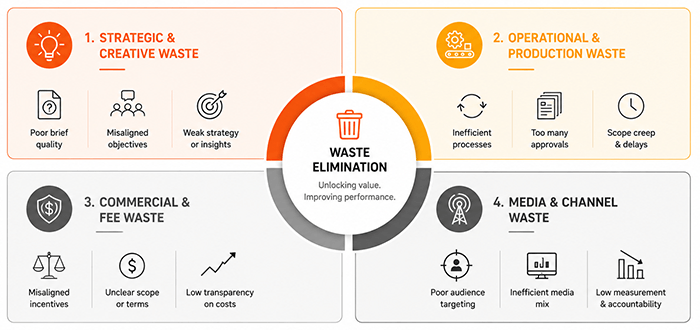
To effectively reduce waste, a procurement manager must first precisely identify where it occurs. Waste in marketing is rarely a single-source problem; it is systemic, fueled by poor processes, misaligned incentives, and a lack of transparency. These areas represent prime opportunities for procurement intervention, guided by TrinityP3’s diagnostic expertise.
Conceptual Shift: From Price Focus to Performance Focus
Procurement’s mandate shifts from reducing the price of inputs to minimising the cost of failures, as illustrated below:
| Focus Area | Old Mandate (Cost Control) | New Mandate (Waste Elimination) | Primary Financial Impact |
| Agency Rates | Lowering Agency Rates | Reducing Rework Cycles | Lower Operational Costs |
| Briefing & Inputs | Discount Negotiation | Improving Brief Quality | Higher Campaign Effectiveness |
| Commercial Risk | Reducing Fee % | Mitigating Legal/IP Risk | Reduced Financial Liability |
| Sourcing Model | Transactional Sourcing | Strategic Value Architecture | Increased Marketing ROI |
3.1. Strategic & Creative Waste (The Briefing Failure)
This is the most insidious and costly form of waste, often occurring before a single dollar is spent on media or production. It results from a failure to define the mission clearly.
| Waste Indicator | Waste Mechanism | Procurement Intervention (TrinityP3 Alignment) |
| Poor/Ambiguous Briefs | Lack of clear objectives, audience, or measurement criteria forces the agency to guess. This leads directly to multiple rounds of expensive creative rework. | Marketing Operations Practice (Marketing Transformation): Procurement facilitates the creation and adoption of standardised, rigorous briefing templates and governance processes that enforce clarity and accountability before any agency time is spent. |
| Creative Duplication | Different agencies (or internal teams) creating similar assets or failing to leverage existing brand guidelines/ libraries, leading to unnecessary effort and spend. | Production Consultancy (Asset Management Review): Analysing asset creation workflows to identify duplication, establishing central Digital Asset Management (DAM) systems, and maximising asset longevity across markets. |
| Misaligned Goals | Agency remuneration and KPIs focus on output quantity (e.g., number of assets produced) rather than business outcome (e.g., sales lift), resulting in technically ‘successful’ work that fails the business. | Procurement Advisory (Contract & Performance Structure): Procurement integrates marketing effectiveness metrics (e.g., ROI, funnel conversion rates) directly into contracts and performance mechanisms. |
3.2. Operational & Production Waste (The Workflow Drag)
This category focuses on the operational inefficiencies within the delivery of communications assets, a key area for TrinityP3’s Production Consultancy.
| Waste Indicator | Waste Mechanism | Procurement Intervention (TrinityP3 Alignment) |
| Inefficient Workflow | Excessive handoffs, unclear roles, and slow internal approvals that create project bottlenecks, delay time-to-market, and increase premium rush costs. | Production Consultancy (Workflow Prioritisation Tools): Advising on and implementing centralised workflow management tools and streamlined approval paths to accelerate production speed and reduce administrative overhead. |
| Unoptimised Internal Studio | Lack of commercial rigour, poor utilisation tracking, undefined scope, and low productivity from captive in-house resources. | Production Consultancy & Marketing Operations: Applying commercial performance metrics (e.g., utilisation, speed-to-market) to the in-house function to ensure it operates with the same efficiency as a best-in-class external vendor. |
| Over-Specification | Marketing teams unnecessarily demanding premium, high-cost materials, specialised formats, or inflated production values that do not contribute meaningfully to the communication’s effectiveness or required reach. | Production Consultancy (Production Evaluation & Benchmarking): Using objective cost and process benchmarking to challenge “market norms” and ensure specifications are strictly fit-for-purpose rather than merely high-cost luxuries. |
| Version Sprawl | Inefficient local market adaptation or versioning due to decentralised production, leading to excessive administrative overhead and costly errors in execution across global regions. | Marketing Operations (Operating Model Design): Helping marketing teams architect centralised or hub-and-spoke production models that standardise adaptation, reducing local market production overhead and error rates. |
3.3. Commercial & Remuneration Waste (The Fee Flaw)
This waste occurs when the commercial structure itself drives the wrong behaviours or creates unnecessary financial exposure, addressed by TrinityP3’s Agency Commercial services.
| Waste Indicator | Waste Mechanism | Procurement Intervention (TrinityP3 Alignment) |
| Ambiguous Scope of Work (SOW) | Vague SOWs force agencies to “over-quote” to cover assumed risk, resulting in overpayment or high, unbudgeted costs via scope creep. | Agency Commercial (SOW Structuring & Benchmarking): Utilising global benchmarking data to help marketing define a detailed, quantifiable SOW (not just a campaign wish list), ensuring the fee is fit-for-purpose for the actual delivery volume. |
| Misaligned Fee Models | Paying retainer models for project-based work, or complex hourly rates for simple output. This leads to underutilised resources or excessive project fees, creating a mismatch between work type and compensation. | Agency Advisory (Fee Model Optimisation): Recommending and implementing flexible fee models (e.g., performance-based, output-based, hybrid) that align compensation with the specific type of service and incentivise efficiency and productivity. |
| Lack of Transparency | Hidden markups on third-party costs (e.g., freelancers, production suppliers, data) or opaque media trading practices, leading to inflated total costs and a breakdown of trust. | Media & Production Consultancy (Financial Audits): Conducting detailed financial and media supply chain audits to enforce transparency clauses and ensure all costs are verifiable, market-competitive, and free of undisclosed revenue streams. |
3.4. Media and Channel Waste (The Effectiveness Gap)
Waste that occurs when the message fails to reach the right audience, or reaches them in a way that is financially, ethically, or environmentally unsound.
| Waste Indicator | Waste Mechanism | Procurement Intervention (TrinityP3 Alignment) |
| Ad Fraud & Low Viewability | Paying for impressions that are fraudulent, non-viewable, or served out of context. This is a direct financial loss and waste of media budget. | Media Advisory & Value Consultancy (Media Operational Reviews): Establishing rigorous contractual standards for media verification, ad fraud filtering, and viewability benchmarks (e.g., MRC standards). |
| Environmental Cost (Carbon Footprint) | Media choices that, while cheap on CPM, carry a significant carbon impact (e.g., excessive programmatic auction calls), creating a growing risk to corporate sustainability goals. | Media Sustainability Optimisation: Incorporating the carbon cost of communication as a measurable factor in media selection and agency tenders, aligning procurement choices with the organisation’s broader ESG agenda. |
| Channel Redundancy | Attempting to be “everywhere” instead of focusing on the few channels most relevant to the target audience, resulting in budget dilution and reduced cut-through. | Marketing Transformation & Procurement Advisory: Using data and effectiveness studies to rationalise media investment across fewer, more impactful channels, promoting the TrinityP3 philosophy of “doing less, not more” for greater effect. |
4. AI in Marketing Communications: Opportunity, Risk, and the New Frontier of Waste
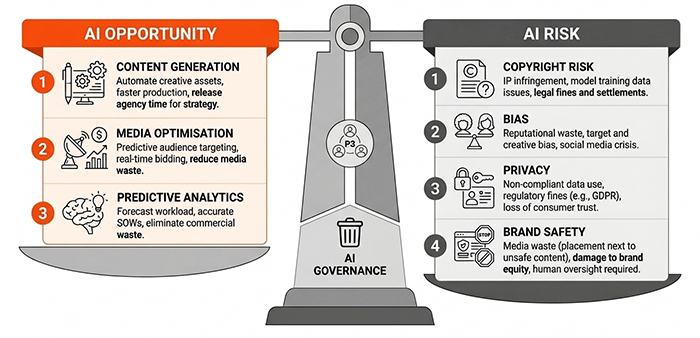
The rapid adoption of Artificial Intelligence (AI) and Machine Learning (ML) across the marketing ecosystem presents a unique challenge for Procurement. It offers immense potential for efficiency, but introduces significant commercial, ethical, and legal risks that can create catastrophic waste if not proactively managed. Procurement must act as the organisation’s Chief Risk Mitigator in this space.
4.1. The AI Opportunity: Turbocharging Waste Elimination
- Generative AI (Content/Creative): GenAI tools can automate early-stage creative asset generation, adaptation, and versioning for multiple channels This dramatically reduces the cost and time of manual labour, eliminating operational waste and freeing up agency time for high-value strategic thinking. Procurement’s role is to ensure agency fees are adjusted to reflect this machine efficiency.
- Media Optimisation and Predictive Bidding: ML algorithms can predict audience behaviour and optimise programmatic bidding in real-time, eliminating media waste by ensuring impressions are served to high-intent audiences and minimising non-viewable inventory.
- Predictive Analytics for SOW: AI can forecast workload, project scope, and resource needs with greater accuracy than human planners. This translates directly into tighter, more accurate Scopes of Work (SOWs), eliminating the commercial waste inherent in vague or padded scopes.
4.2. The AI Risk & Procurement Mitigation Matrix
The efficiency gains of AI are tempered by novel risks that can result in massive, high-impact waste. Procurement’s vigilance here is non-negotiable.
| Waste Indicator | Waste Mechanism | Procurement Intervention (TrinityP3 Alignment) |
| Inefficient Workflow | Excessive handoffs, unclear roles, and slow internal approvals that create project bottlenecks, delay time-to-market, and increase premium rush costs. | Production Consultancy (Workflow Prioritisation Tools): Advising on and implementing centralised workflow management tools and streamlined approval paths to accelerate production speed and reduce administrative overhead. |
| Unoptimised Internal Studio | Lack of commercial rigour, poor utilisation tracking, undefined scope, and low productivity from captive in-house resources. | Production Consultancy & Marketing Operations: Applying commercial performance metrics (e.g., utilisation, speed-to-market) to the in-house function to ensure it operates with the same efficiency as a best-in-class external vendor. |
| Over-Specification | Marketing teams unnecessarily demanding premium, high-cost materials, specialised formats, or inflated production values that do not contribute meaningfully to the communication’s effectiveness or required reach. | Production Consultancy (Production Evaluation & Benchmarking): Using objective cost and process benchmarking to challenge “market norms” and ensure specifications are strictly fit-for-purpose rather than merely high-cost luxuries. |
| Version Sprawl | Inefficient local market adaptation or versioning due to decentralised production, leading to excessive administrative overhead and costly errors in execution across global regions. | Marketing Operations (Operating Model Design): Helping marketing teams architect centralised or hub-and-spoke production models that standardise adaptation, reducing local market production overhead and error rates. |
5. The TrinityP3 P3 Framework: Architecting Value
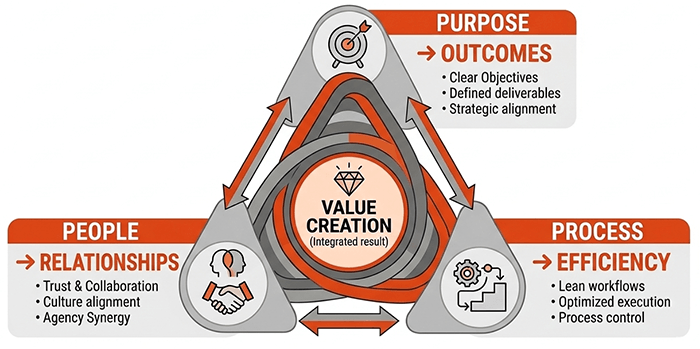
To transition from cost-centric to value-centric procurement, managers must structure their actions around the Purpose, People, and Process (P3) framework – the cornerstone of TrinityP3’s methodology.
P3 Framework: The Pillars of Value Architecture
| Pillar | Focus | Procurement Deliverable | Waste Eliminated |
| Purpose | Aligning Incentives & Outcomes | Performance-Based Contracts & Clear SOWs | Commercial Waste & Sub-optimal Effectiveness |
| People | Fostering Trust & Collaboration | Joint Operating Agreements & Relationship Assessments | Strained Relationships & Internal Friction |
| Process | Driving Efficiency & Rigor | Standardised Briefing Tools & Workflow Audits | Operational Waste & Rework Cycles |
5.1. Purpose: Aligning Outcomes and Commercial Models
- Redefining the Value Metric: Procurement must shift the negotiation focus from the price of inputs (e.g., hourly rates) to the value of outputs (e.g., effectiveness score, time-to-market reduction, marketing ROI).
- Architecting the Scope of Value: Utilise TrinityP3’s Agency Commercial and Benchmarking services to define a detailed, multi-layered SOW that clearly separates high-value strategic input from low-value tactical execution.
- Implementing Performance-Based Contracts: Procurement must embed KPIs tied to marketing effectiveness into the remuneration structure, balancing a lower base fee with a significant bonus pool tied to objective, third-party verifiable outcomes.
5.2. People: Fostering Strategic Partnership and Managing In-House Functions
- The Strategic Make vs. Buy Decision: Procurement must leverage TrinityP3’s Agency Roster Assessment methodology to conduct a strategic Make Buy analysis to determine which tasks are most efficiently and effectively handled by the in-house team versus external partners.
- Optimising In-House Agency Productivity: Compare internal output rates, overhead allocation, and project turnaround times against external benchmarks to ensure the internal agency model drives true operational productivity rather than structural bloat.
- Mitigating Risks Within the In-House Team: Ensure that internal teams adhere to strict risk governance, including data privacy policies and intellectual property clearance protocols, particularly when internal teams deploy Generative AI.
- Be the ‘United Front’: Procurement and Marketing must present a united front during agency selection and negotiation, blending commercial rigour with brand insight.
5.3. Process: Establishing Operational Rigour
- Production Consultancy Integration: Leverage TrinityP3’s Production Consultancy to formally review the entire production supply chain, including internal studios, to remove wasteful steps and ensure a Lean
- The RFP as a Process Assessment Tool: Prioritise finding agencies that can demonstrate process efficiency, clear operational transparency, and strong internal governance rather than just low rates.
6. Procurement's Strategic Role: From Gatekeeper to Risk Mitigator
6.1. The Strategic Sourcing of Effectiveness
Total Cost of Ownership (TCO) Thinking: Procurement must model the full lifecycle of a marketing investment, including the hidden costs of poor quality: internal time spent on endless revisions, campaign opportunity cost due to delays, and the cost of having to re-run an ineffective campaign. When TCO is accurately calculated, the “cheapest” rate often proves to be the most wasteful choice overall.
Productivity Benchmarking: Ditch the obsession with the hourly rate. Procurement must focus diligence on productivity benchmarking – how efficiently and effectively the agency translates a cost base into output and outcome. TrinityP3’s global benchmarks allow procurement to assess whether the proposed team structure is appropriately staffed and resourced for the defined SOW.
6.2. Governance and AI Risk Prevention
Procurement must enforce a mandatory checkpoint for every project utilising external AI/GenAI services, applying equally to work performed by in-house agency functions. This checkpoint verifies IP indemnification, data compliance, and bias audits. Furthermore, all media contracts must contain non-negotiable clauses for third-party auditing, verification of viewability, and reporting on media supply chain costs, as recommended by TrinityP3’s Media Advisory practice.
7. The Strategic Marketing Procurement Plan (SMAP): A Blueprint for Performance
To operationalise this new mandate, Procurement must move beyond reactive task management and implement a structured, multi-year plan.
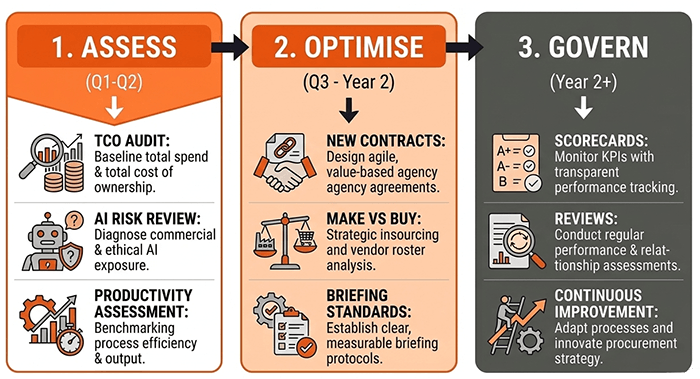
SMAP Timeline: A Three-Phase Implementation Roadmap
| Phase | Duration | Core Goal | Key Activities & TrinityP3 Alignment |
| Phase 1: Assess & Diagnose | Year 1, Q1-Q2 | Establish Baseline for Waste and Risk Exposure | Complete TCO Audit; Roster Size vs. Utilisation Benchmarking; AI Risk baseline; In-house productivity assessment. Alignment: Marketing Performance Audit, Production Consultancy |
| Phase 2: Optimize & Structure | Year 1, Q3 – Year 2, Q2 | Implement P3 Framework & Eliminate Structural Waste | New MSA Templates (with AI indemnity); Performance-based fee structures; Strategic Make vs. Buy finalized; JOA Signed. Alignment: Agency Commercial, Agency Selection, Procurement Advisory |
| Phase 3: Govern & Measure | Ongoing (Year 2+) | Ensure Sustainable Value and Continuous Improvement | Quarterly Performance Scorecards; Annual Partner Value Reviews; MarTech Stack Rationalisation; Future Risk Briefings. Alignment: Agency Performance Assessment, Financial Audits, Marketing Transformation |
The modern procurement manager’s mandate is not about saving 5% on an hourly rate. It is about preventing \$5 million in lost revenue due to a flawed briefing, \$10 million in legal fines from non-compliant AI use, or \ $20 million in wasted media spend on ineffective channels. The shift from cost control to waste elimination is the definitive strategic pivot for the procurement function.
By adopting the Strategic Marketing Procurement Plan (SMAP) and anchoring their strategy in the P3 (Purpose, People, Process) framework, procurement professionals, empowered by the market insights and methodologies of TrinityP3, can fully embrace their role as Value Architects. In the complex, fast-moving world of modern marketing, procurement is no longer a necessary evil; it is the future-proofing partner – the indispensable force that ensures every dollar invested in marketing communications is an effective, high-performing dollar, driving resilient and sustainable business growth.