
Structural Governance, Commercial Alignment, and Operating Model Velocity
Moving Beyond the Martech Fixation
1. Why Modern Marketers Urgently Need Marketing Operations Management
2. Defining Marketing Operations Management in the Enterprise
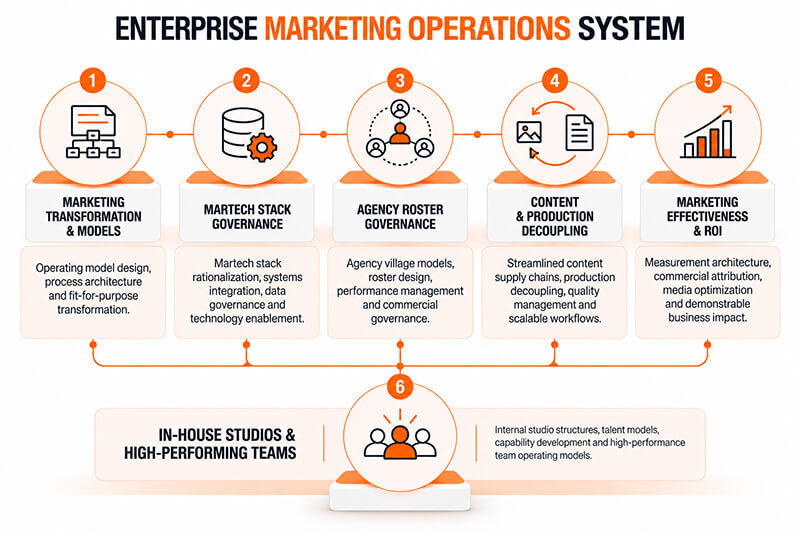
3. The 6 Pillars of TrinityP3 Marketing Operations Management
4. The Proprietary TrinityP3 Diagnostic Toolkit
5. The Enterprise Marketing Ops Maturity Matrix
6. Modernizing Commercial Governance in the Era of Generative AI
7. The 90-Day Marketing Operations Transformation Roadmap
8. Frequently Asked Questions (FAQ)
Moving From Administrative Friction to Operational Velocity
Marketing Operations Diagnostic: Are You Built for High-Velocity Marketing?
Prefer to read it later? Fill out the form below to download a PDF copy of the guide and read it at your convenience.
Moving Beyond the Martech Fixation
For more than a decade, the enterprise conversation surrounding Marketing Operations (Marketing Ops) has been dominated by technology vendors. Marketers have been told that agility, personalization, and productivity are functions of software acquisition. As a result, global marketing organizations have accumulated vast, unwieldy technology stacks, often running dozens of disconnected platforms, while campaign speed-to-market has slowed, internal team burnout has reached record levels, and agency roster relationships have deteriorated into administrative gridlock.
Technology is merely an enabler. Without robust operational architecture, disciplined process engineering, commercial governance, and independent oversight, adding software to a dysfunctional marketing organization does not solve problems, it accelerates chaos.
True Marketing Operations Management is the strategic discipline of designing, governing, and optimizing the complete operating ecosystem of modern marketing: the people, internal workflows, external agency rosters, production supply chains, commercial agreements, and diagnostic metrics required to translate corporate strategy into measurable, profitable business growth.
This guide provides enterprise Chief Marketing Officers (CMOs), Heads of Marketing Operations, and Procurement leaders with a vendor-neutral, commercially rigorous blueprint for building a high-velocity marketing operations ecosystem.
1. Why Modern Marketers Urgently Need Marketing Operations Management
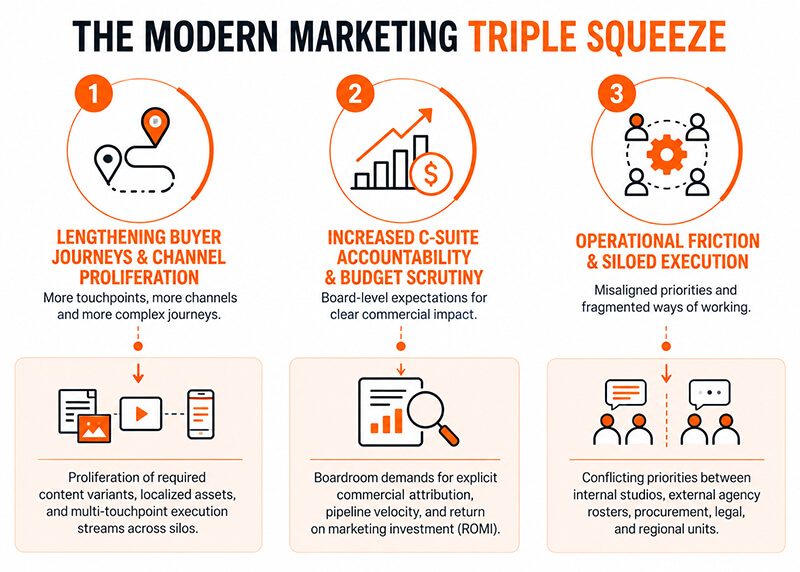
Enterprise marketing has undergone a structural shift. The operational complexity confronting modern marketing leaders is historically unprecedented. Organizations that treat operations as an afterthought or an administrative support desk find their strategic initiatives grinding to a halt under the weight of three compounding pressures:
The Productivity Paradox
Over the past five years, enterprise software spend has skyrocketed, yet marketing campaign cycle times have frequently doubled. This is the Marketing Productivity Paradox.
When internal marketing teams spend up to 25% of their working hours manually compiling vanity metrics, searching for digital assets across fractured storage systems, or navigating recursive approval chains, creative and strategic bandwidth disappears. Adding another project management or digital asset management (DAM) tool does not resolve the bottleneck if the underlying briefing standards and decision rights are broken.
The Bridge Between Vision and Execution
Marketing strategy defines where a brand wants to go and what it must communicate. Marketing operations management establishes how the enterprise actually gets there. Without a dedicated operational discipline:
- Strategy degrades into tactical firefighting: High-value strategists become operational air-traffic controllers.
- Agency relationships decay: Misaligned scopes of work (SOWs), unclear briefs, and shifting priorities breed mutual resentment between internal brand managers and external agency partners.
- Commercial leakage multiplies: Budgets bleed through opaque programmatic digital media supply chains, unmonitored production markups, and redundant technology retainers.
Marketing Operations Management provides the organizational scaffolding that protects the marketing budget, eliminates structural waste, and ensures creative and commercial excellence can scale sustainably.
2. Defining Marketing Operations Management in the Enterprise
To evaluate and optimize marketing operations, organizations must first adopt an unambiguous, commercially grounded definition.
What is Marketing Operations Management?
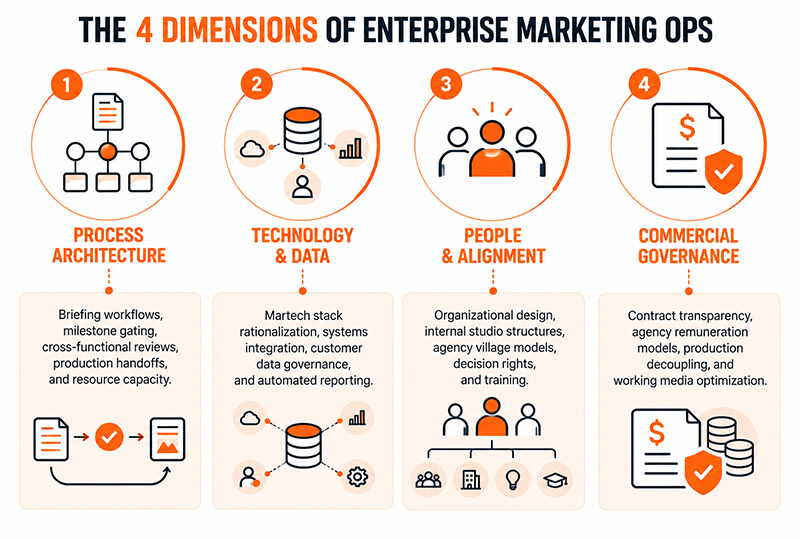
Marketing Operations Management is the strategic governance, process architecture, technological integration, and commercial oversight of the end-to-end marketing ecosystem. It orchestrates internal cross-functional teams, external agency rosters, technology stacks, production supply chains, and procurement frameworks to ensure marketing investments deliver maximum operational throughput, brand compliance, and verifiable commercial return on investment (ROI).
Unlike functional marketing teams focused on creative conception, media planning, or brand management, Marketing Operations operates as the operating system of the marketing organization.
How Marketing Ops Differs from Traditional Marketing, IT, and Procurement
- Marketing Ops vs. Brand Marketing: Brand marketing focuses on market positioning, consumer insight, creative concepts, and campaign messaging. Marketing Ops focuses on the execution infrastructure, throughput velocity, resource allocation, and workflow governance that allow those concepts to reach the market efficiently.
- Marketing Ops vs. Information Technology (IT): Corporate IT evaluates software based on enterprise security, data infrastructure, compliance, and enterprise license agreements. Marketing Ops evaluates marketing technology based on marketer adoption, workflow integration, campaign lifecycle fit, and business outcome enablement.
- Marketing Ops vs. Traditional Procurement: Traditional procurement often treats agency and media expenditure as an indirect cost category to be trimmed through arbitrary hourly-rate reductions. Strategic Marketing Ops collaborates with procurement as a Value Architect, aligning commercial contracts, agency remuneration, and production models to business value rather than commodity hours.
3. The 6 Pillars of TrinityP3 Marketing Operations Management
TrinityP3 approaches Marketing Operations Management through a comprehensive, vendor-neutral framework designed specifically for complex enterprise and mid-market organizations.
Pillar 1: Marketing Transformation & Operating Model Design
An operating model is the blueprint for how an organization configures its people, processes, and technology to deliver on its strategic objectives. Enterprise marketing transformations frequently fail because organizations attempt to adopt new strategies while retaining obsolete organizational structures.
The Core Challenges
- Consensus Paralysis: Decentralised decision-making across matrixed regional and product silos where every stakeholder holds an informal veto.
- Functional Fragmentation: Digital, brand, performance, product, and communications teams operating in distinct silos with competing priorities and redundant budgets.
- Unclear Decision Rights: Ambiguity surrounding who has final approval authority over campaign strategy, creative executions, media allocations, and technology investments.
How TrinityP3 Optimizes Operating Models
- Diagnostic Capability Auditing: We assess existing organizational capabilities across skills, technology utilisation, and operational capacity to identify structural gaps and operational redundancies.
- Decision Rights Codification: We design explicit governance frameworks that establish who is Accountable/Driver for final sign-off versus who is merely Consulted or Informed, eliminating review loops and decision gridlock.
- Agile Workflow Integration: We implement tailored operational rhythms—balancing centralized governance with decentralized regional execution agility, ensuring global consistency without sacrificing local market speed.
Pillar 2: Marketing Technology (Martech) Stack Governance & Utilization
The global martech landscape now contains over 14,000 distinct solutions. This explosion of software has created enterprise environments characterized by duplicate tools, low user adoption, and unintegrated data siloes.
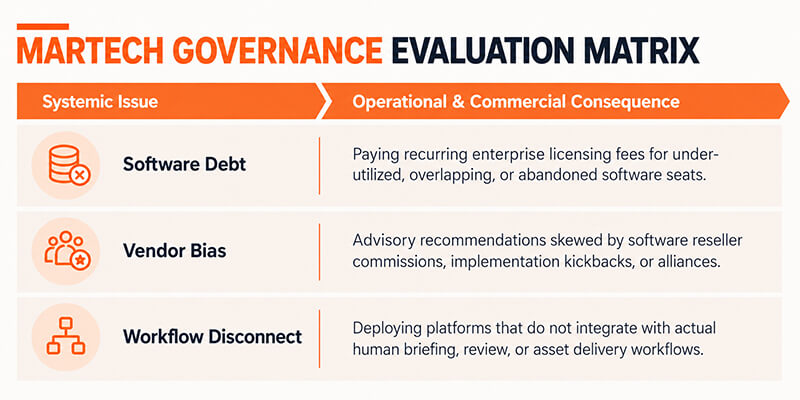
How TrinityP3 Governs Marketing Technology
- 100% Vendor-Neutral Auditing: TrinityP3 accepts zero referral fees, reseller commissions, or software implementation alliances. Our technology audits are conducted with absolute independence, evaluating tools exclusively on enterprise fit and business ROI.
- Utilization & Redundancy Audits: We evaluate your entire software inventory to identify duplicate functionality (e.g., multiple project management tools across brand and regional teams), quantify actual seat utilization, and recommend aggressive software decommissioning.
- Workflow-First Platform Configuration: We align technology platforms directly with human processes. Software must serve the workflow, not dictate it. We ensure DAM, Work Management, and CRM platforms integrate seamlessly across internal marketing, studio teams, and external agencies.
Pillar 3: Strategic Procurement Advisory & Agency Roster Governance
Enterprise marketing spend is frequently an organization’s largest indirect expenditure category. However, when marketing and procurement operate with misaligned incentives, value is destroyed: procurement focuses narrowly on driving down hourly rates, while marketing struggles with compromised agency quality, high agency staff turnover, and hidden costs.
Moving from Rate Squeezing to Value Architecture
Modern Marketing Operations requires procurement and marketing to act as joint Value Architects. The objective is not to secure the cheapest hourly rate—which incentivizes agencies to assign junior staff and bill more hours—but to build commercial arrangements that reward speed, quality, and business performance.
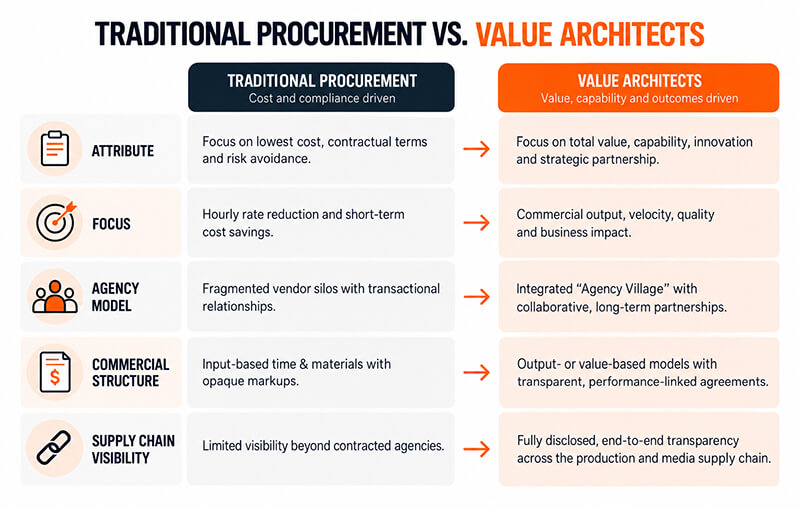
How TrinityP3 Governs Agency Rosters
- Roster Structural Design: We evaluate whether your roster structure (e.g., lead agency, specialized best-of-breed, or holding company model) matches your operational complexity and media spend.
- The “Agency Village” Framework: We build collaborative operating models where creative, media, digital, performance, and PR agencies operate under shared SLAs, unified communications protocols, and aligned performance bonuses.
- Commercial Contract Modernization: We structure clear, enforceable Statements of Work (SOWs) and transition contracts away from legacy head-hour models toward transparent deliverable- and outcome-based pricing.
- Media Supply Chain Transparency: We audit programmatic media trading desk margins, technology markups, and rebate arrangements, ensuring enterprise spend is directed into measurable working media.
Pillar 4: Production Consultancy & Content Ecosystem Decoupling
The demand for high-volume, multi-variant digital, social, and personalized content has outpaced traditional agency production models. When high-cost creative agencies handle routine content adaptation and digital production, budgets are consumed by administrative agency overhead.
The Decoupling Imperative
Decoupling involves separating the strategic and conceptual creative ideation process from the physical production, adaptation, and versioning of marketing assets.
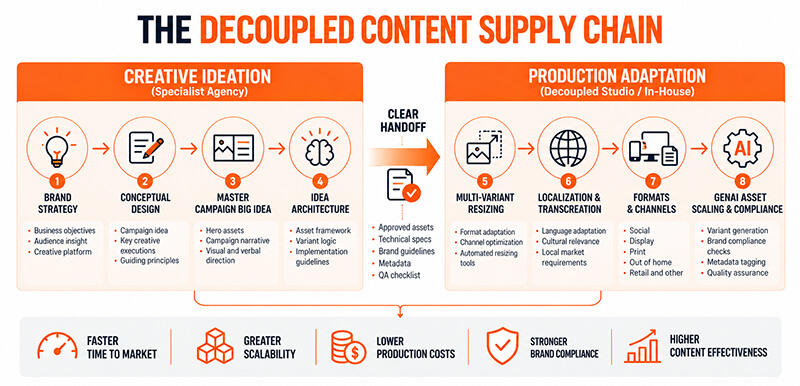
How TrinityP3 Optimizes Production Ecosystems
- Production Supply Chain Audits: We analyse end-to-end production expenditures across broadcast, digital, print, and experiential channels to identify inflated markups and inefficient workflows.
- Decoupling Strategy & Execution: We help organizations establish dedicated production partnerships or internal hubs, reducing asset adaptation costs by 30% to 50% while accelerating delivery timelines.
GenAI Production Governance: We establish commercial and legal guardrails for Generative AI in the creative supply chain. We ensure agencies pass automation efficiencies back to the enterprise rather than billing manual hours for automated work, while safeguarding corporate IP and data privacy.
Pillar 5: Marketing Effectiveness, Measurement Architecture & Diagnostic Commercial ROI
Marketing operations cannot justify its existence through operational activity alone; it must prove its contribution to enterprise financial performance. Historically, MOps reporting has been bogged down in tactical platform metrics (e.g., open rates, impressions, cost-per-click) that fail to resonate with executive leadership or boards of directors.
The Three Tiers of Marketing Operations Measurement
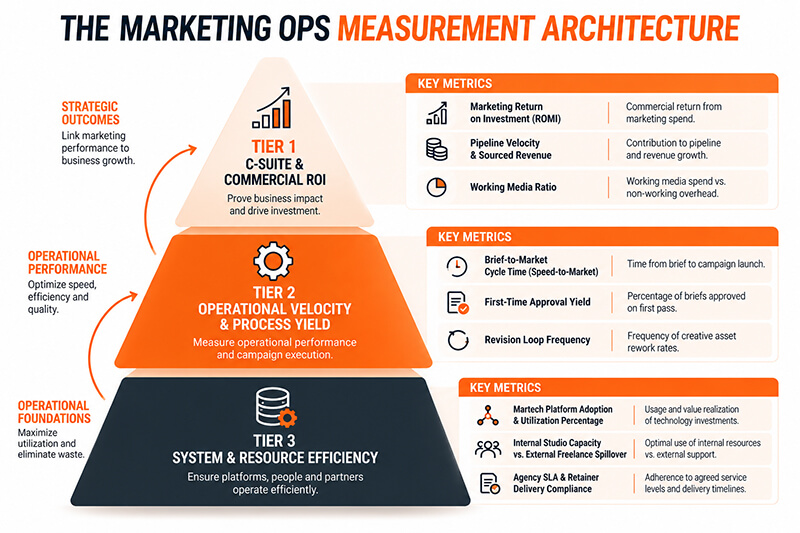
How TrinityP3 Drives Marketing Effectiveness
- Diagnostic Commercial Attribution: We align operational throughput metrics with commercial performance indicators, moving beyond vanity metrics to track revenue impact.
- Eliminating Non-Working Budget Waste: We benchmark non-working expenditure (agency management fees, redundant tech, production markup) against industry norms, redirecting savings into working brand and performance media.
- Automated Diagnostic Reporting: We design automated performance dashboards that provide continuous visibility into campaign velocity, operational bottlenecks, and financial burn rates.
Pillar 6: High-Performing Teams & In-House Agency Advisory
Many enterprises have in-housed creative, digital, and media capabilities to regain control over their marketing agility and cut agency costs. However, without rigorous operational governance, in-house agencies rapidly become overburdened, inefficient, and demoralized cost centres.
Common Failures of In-House Models
- The “Bottomless Pit” Syndrome: Internal business units treat the in-house team as free, unlimited labour, submitting vague briefs and requesting endless revisions because there is no commercial friction.
- Creative Burnout and Talent Churn: In-house teams become overwhelmed with low-tier asset resizing and administrative chores, losing top creative talent due to the lack of strategic, high-value work.
- Lack of SLAs and Capacity Governance: Without formal Service Level Agreements and resource allocation frameworks, in-house studios miss deadlines, forcing marketing managers to hire external freelance support at premium rates.
How TrinityP3 Builds High-Performing In-House Ecosystems
- Operating Model & Charter Definition: We establish a clear strategic charter for the in-house team, defining which work must stay internal (e.g., fast-turnaround digital, confidential product marketing) and which should remain with external agency partners.
- Commercial Rate-Card & Resource Modelling: We establish internal chargeback or virtual billing models that apply healthy commercial discipline to internal briefing habits.
- Briefing Governance & First-Time Yield: We implement strict briefing quality filters: work does not enter the studio queue until briefs meet commercial completeness criteria, eliminating rework cycles at the source.
4. The Proprietary TrinityP3 Diagnostic Toolkit
Enterprise transformation requires empirical data rather than qualitative assumptions. TrinityP3 deploys a suite of proprietary diagnostic tools to deliver objective, industry-benchmarked insights into your marketing operations ecosystem.
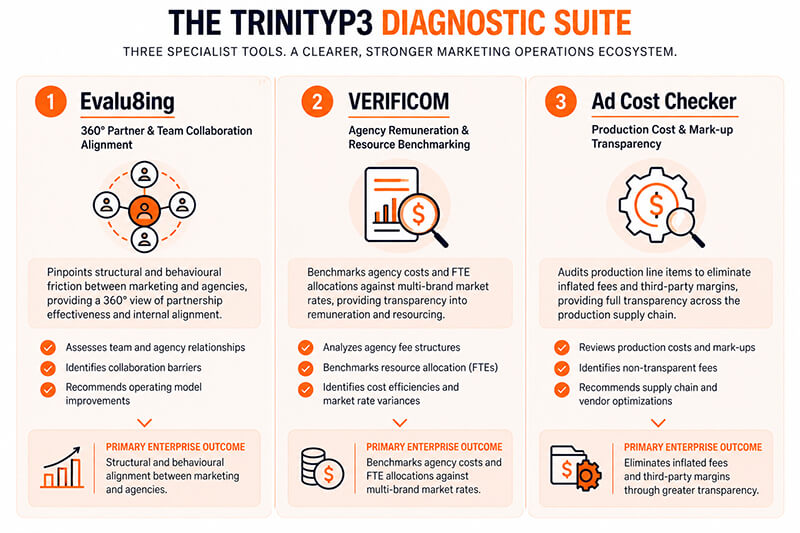
Evalu8ing: Transforming Ecosystem Relationships
Collaboration breakdown between marketing teams and external agency partners is an operational bottleneck that drains campaign momentum. Evalu8ing is TrinityP3’s proprietary 360-degree performance evaluation platform. It systematically collects and analyses multidirectional feedback across marketing, procurement, and agency stakeholders.
By identifying specific operational friction points—such as ambiguous briefs, protracted approval times, or misaligned scope expectations—Evalu8ing replaces emotional disputes with actionable, objective diagnostic data.
Verificom: Empirical Remuneration Benchmarking
How do you know if you are overpaying—or underpaying—your external agency partners? VERIFICOM matches your agency scopes of work, staffing plans, and retainer models against an algorithm based on a massive empirical database of multi-brand, cross-industry commercial agreements.
It provides procurement and marketing leaders with market-tested validation, ensuring fair, sustainable compensation models that protect agency talent quality while preventing enterprise budget waste.
Ad Cost Checker: Granular Production Rate Governance
Content production involves opaque supply chains filled with specialized subcontractors, equipment rentals, talent buyouts, and post-production studios. Ad Cost Checker provides comprehensive, line-item benchmarking of production estimates before budgets are committed.
By auditing production bids against objective market rates, Ad Cost Checker guarantees that production budgets are spent on screen-level craft rather than unnecessary vendor markups.
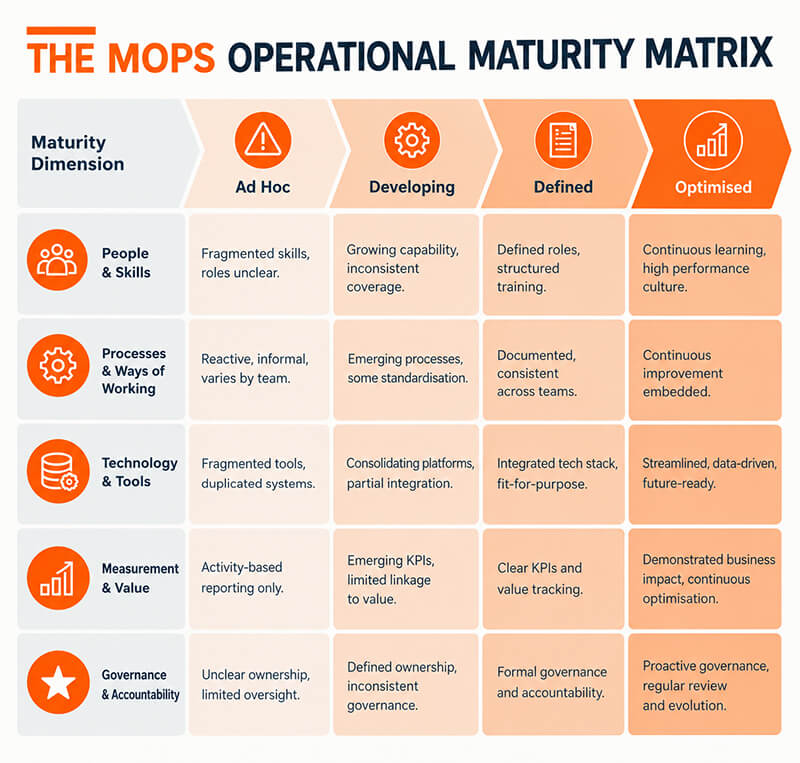
5. The Enterprise Marketing Ops Maturity Matrix
Organizations do not achieve operational excellence overnight. Marketing operations maturity evolves through four distinct stages:
6. Modernizing Commercial Governance in the Era of Generative AI
The rapid adoption of Generative AI represents the most disruptive operational shift in enterprise marketing since the advent of digital programmatic advertising. However, AI’s greatest challenge to marketing operations is commercial rather than technical.
The Breakdown of the Head-Hour Billing Model
For more than thirty years, external creative, digital, and production agencies have billed clients based on the Time and Materials (Head-Hour) model. Under this construct:
Agency Cost = Labor Hours Worked × Hourly Rate Card + Margin
This model creates a profound perverse commercial incentive: the longer an agency takes to execute an asset, the more money it earns.
Generative AI fundamentally breaks this dynamic by decoupling labour time from output volume. Tasks that historically required 40 human hours (e.g., resizing display ads, formatting multi-lingual email copy, producing photographic variations) can now be executed in seconds.
If your agency agreements remain tied to head-hour rate cards, your organization faces two distinct risks:
- Subsidizing Vendor Margins: The agency utilizes internal GenAI tools to produce work in minutes while continuing to bill your contract for standard manual hours.
- Penalizing Innovation: An agency that transparently adopts AI and reduces its billable hours sees its revenue collapse, creating a disincentive for efficiency.
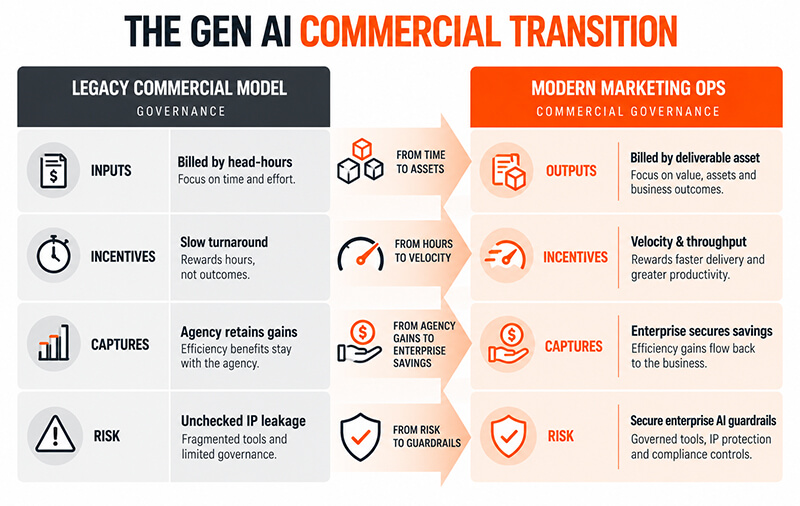
The Modern Marketing Ops Response: Value- and Output-Based Fees
TrinityP3 helps enterprise marketing and procurement leaders restructure agency agreements to capture the benefits of generative automation:
- Output-Based Pricing Matrices: We replace arbitrary head-hours with standardized cost-per-deliverable frameworks, ensuring enterprise budgets reflect real automation efficiencies.
- GenAI Governance Protocols: We establish strict legal, ethical, and operational contractual terms regarding where client data can be processed, ensuring proprietary IP is never ingested into public LLMs.
- Fair Value Sharing: We structure win-win commercial agreements that provide agencies with margin incentives for innovation and campaign velocity, rather than rewarding bureaucratic delays.
7. The 90-Day Marketing Operations Transformation Roadmap
Transforming enterprise marketing operations requires a structured, phased approach that delivers immediate operational stabilization while building long-term architectural governance.
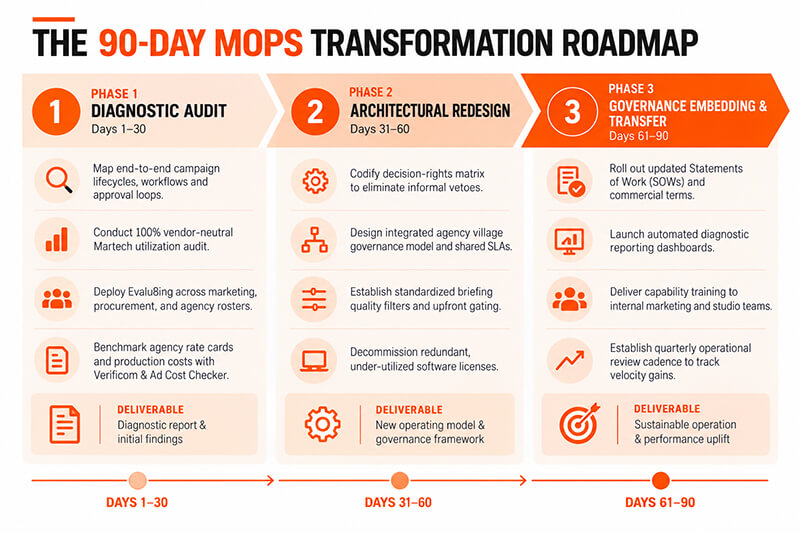
Phase 1: Diagnostic Assessment & Operational Audit (Days 1–30)
- Workflow Mapping: Document the actual path a campaign brief takes from initial business need through execution, pinpointing bottlenecks, rework loops, and shadow approvals.
- Commercial Benchmarking: Deploy TrinityP3’s Verificom and Ad Cost Checker to assess whether agency retainers, media trading desk practices, and production costs align with market standards.
- Stakeholder Alignment: Conduct an Evalu8ing assessment across internal marketing teams, procurement, and external agencies to establish an empirical baseline of operational health.
Phase 2: Structural Redesign & Commercial Governance (Days 31–60)
- Governance Engineering: Formulate clear decision-rights matrices. Define exactly who has sign-off authority at each campaign stage, removing committee-based consensus paralysis.
- Roster Alignment: Draft shared Engagement Agreement and collaboration protocols for the agency village, defining clear division of responsibilities between creative, media, and in-house studios.
- Martech Rationalization: Identify and terminate redundant software licenses, consolidating workflow management into a single, enforced operating stack.
Phase 3: Governance Embedding & Capability Transfer (Days 61–90)
- Commercial Implementation: Transition external agency contracts to output- or value-based models, embedding transparent pass-through auditing rights.
- Briefing Gate Enforcement: Implement strict quality criteria for new briefs. Briefs that fail to provide necessary strategic and commercial information are rejected before studio or agency hours are burned.
- Capability Upskilling: Train internal teams and agency partners on the new operating rhythms, ensuring the transformed operating model becomes standard operating procedure long after the consulting engagement concludes.
8. Frequently Asked Questions (FAQ)
What is the difference between brand strategy consulting and marketing operations management?
Brand strategy defines what a brand communicates to the marketplace, its value proposition, and its creative identity. Marketing Operations Management engineers the operational, commercial, procedural, and technological infrastructure required to execute that strategy efficiently. Marketing Ops focuses on workflow optimization, technology adoption, agency roster alignment, production decoupling, and resource allocation to ensure strategic ideas reach the market on time and deliver verifiable commercial return.
How does TrinityP3 improve marketing operations productivity without burning out internal teams?
Enterprise teams burn out when they spend their working days navigating operational friction: chasing inputs, attending redundant status meetings, managing endless creative revisions, and acting as administrative coordinators between siloed agencies. TrinityP3 conducts diagnostic reviews across your campaign lifecycle to eliminate these structural bottlenecks. By establishing upfront briefing quality gates, clarifying decision rights, and automating reporting, we eliminate non-value-adding tasks, allowing internal teams to increase productive output by up to 20% while reducing operational fatigue.
What is the specific role of procurement in marketing operations governance?
In high-performing organizations, procurement shifts from a transactional cost-cutting department into a strategic Value Architect. Rather than simply negotiating lower agency hourly rates—which can degrade agency service quality and lead to hidden costs—procurement collaborates with marketing operations to optimize commercial value. This includes implementing output-based remuneration, eliminating non-working fee leakages, ensuring digital media supply chain transparency, and designing sustainable roster architectures.
Why is 100% vendor neutrality essential for a marketing operations consultant?
Many consulting firms and system integrators maintain commercial partnerships, reseller agreements, or referral commissions with martech software vendors and advertising holding companies. These arrangements create an inherent conflict of interest: their recommendations may be influenced by platform sales quotas or downstream implementation fees. TrinityP3 is 100% independent. We accept zero commissions, reseller fees, or agency kickbacks, ensuring every operational recommendation is driven entirely by your business ROI.
How do we measure the business ROI of marketing operations consulting?
The ROI of marketing operations consulting is measured across four concrete operational and financial dimensions:
- Decision Velocity: Achieving a 40% to 50% reduction in approval turnaround times and campaign cycle durations.
- Marketing Productivity: Accelerating campaign speed-to-market by 25% to 35% without expanding internal headcount.
- Process Efficiency: Lowering creative revision loops and briefing rejection rates to under 10%.
- Commercial Value: Realizing a 15% to 20% improvement in effective budget throughput by eliminating non-working agency fees, terminating shelfware, and optimizing media investments.
Moving From Administrative Friction to Operational Velocity
Enterprise marketing success is no longer governed solely by the brilliance of an advertising concept. In an era of compressed timelines, fragmented media ecosystems, and tight budget scrutiny, the organization with the superior operational engine wins.
By treating Marketing Operations Management as a core enterprise discipline—anchored in disciplined process architecture, independent technology governance, transparent commercial models, and objective benchmarking data—marketing and procurement leaders can eliminate operational gridlock, protect their teams from burnout, and build a high-velocity engine for scalable, measurable business growth.