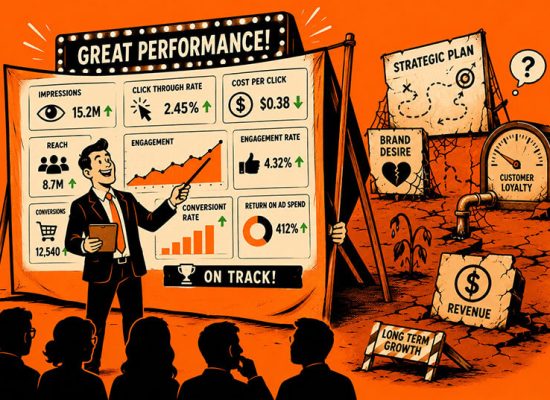

In the modern marketing department, data is the one thing we have in abundance. We are drowning in dashboards, swimming in “real-time” analytics, and constantly bombarded by the latest AI-driven attribution tools promising to reveal the “truth” behind every dollar spent. Yet, despite this technological mountain of evidence, a profound crisis of confidence persists.
For many CMOs, the fundamental question—“Is our marketing actually working?”—remains as difficult to answer today as it was in the era of John Wanamaker. The tragedy is that while we have more ways to measure activity, we seem to have fewer ways to prove effectiveness.
Commercial organisations of all sizes are currently struggling with what we at TrinityP3 call the “Effectiveness Gap”. This is the space between the digital metrics that marketing teams celebrate (clicks, impressions, likes) and the commercial outcomes that the CEO and CFO actually care about (market share, margin, and long-term business growth).
To bridge this gap, we must move beyond the “reporting” mindset and towards a genuine Marketing Effectiveness framework. This is not just about choosing a better software platform; it is about a wholesale transformation of how marketing is valued, measured, and optimised within the business.
The Five Pillars of the Effectiveness Trap
Why is it so hard to get right? In our work with global brands, we consistently see five recurring issues that prevent organisations from achieving true marketing effectiveness.
1. The Strategy-Measurement Disconnect
The most common point of failure occurs before a single dollar is spent. We often see a “Grand Canyon” sized gap between the high-level business strategy and the tactical measurement plan. If the business strategy is to “premiumise the brand,” but the marketing KPIs are focused on “lowest cost-per-acquisition,” the measurement system is effectively incentivising the team to undermine the strategy. Without mapping metrics directly back to strategic pillars, you aren’t measuring success; you’re measuring drift.
2. Metric Myopia: The Vanity Trap
In the digital age, we’ve become obsessed with what is easy to measure rather than what is important to measure. High “engagement rates” feel good in a weekly report, but they rarely correlate directly with sustainable profit. When marketing becomes a game of “optimising the numbers” rather than “optimising the business,” effectiveness suffers.
3. The “Finance Wall” and the Language Barrier
Finance speaks the language of capital allocation, risk, and ROI. Marketing often speaks the language of “brand health” and “reach.” When a CMO cannot explain how a 5% increase in brand awareness will lead to a specific commercial outcome, the CFO views marketing spend as a “cost to be cut” rather than an “investment to be managed.”
4. The Attribution Fallacy
Many organisations are still clinging to “last-click” or “multi-touch” attribution models that are fundamentally flawed. These models over-value short-term, bottom-of-the-funnel tactics, leading to an “attribution bias” that starves long-term brand-building activities of necessary funding.
5. Fragmented Data and Siloed Insights
The modern marketing stack is often a patchwork of disconnected platforms. Without a “single source of truth,” marketers are left trying to piece together a jigsaw puzzle where half the pieces—and the strategic context—are missing.
Moving Towards a Marketing Effectiveness Framework
True marketing effectiveness is the result of aligning Strategy, People, Process, and Technology. At TrinityP3, we help organisations move from “reporting on what happened” to “predicting and driving what will happen.”
Action 1: Map Metrics Back to Strategic Intent
Before looking at a dashboard, you must map your measurement framework to your business strategy. This involves identifying the Strategic Levers (e.g., Increasing Penetration, Improving Retention, or Defending Price Premium) and assigning specific metrics that prove those levers are moving. If a metric doesn’t provide evidence of strategic progress, it should be relegated to a “diagnostic” level or discarded entirely.
Action 2: Define a Unified Measurement Framework
Effectiveness requires a tiered hierarchy where every level supports the one above it:
- Commercial Metrics: The “Boardroom” KPIs (Revenue, Market Share, CLV).
- Strategic Outcomes: The “Effectiveness” KPIs (Brand Salience, Consideration, Price Sensitivity).
- Tactical Metrics: The “Efficiency” KPIs (CPA, Reach, Conversion Rate).
Action 3: Bridge the Gap with Finance
Marketing effectiveness is a “team sport” that includes the CFO. Marketers must learn to talk about “Customer Acquisition Cost” (CAC) and “Life-time Value” (LTV) in ways that align with financial reporting. TrinityP3 often acts as the independent “translator” between these two departments.
Action 4: Balance the “Long and the Short”
A robust effectiveness programme must account for the “delayed” impact of brand advertising. This involves moving beyond simple attribution and embracing Marketing Mix Modelling (MMM) or Econometrics to look at the total business ecosystem—including price changes and competitor activity.
Action 5: Align Agency Incentives
Are your agencies incentivised to drive your business growth, or to spend your media budget? Effective marketing requires an agency roster where remuneration models and KPIs are strategically aligned with your commercial goals.
How TrinityP3 Supports Your Transformation
Implementing a measure of marketing effectiveness is a transformational journey. TrinityP3 provides the expertise to:
- Audit Strategic Alignment: Ensuring your measurement plan actually rewards the execution of your business strategy.
- Develop Custom Effectiveness Frameworks: Tailored to your specific industry and organisational maturity.
- Facilitate Marketing-Finance Alignment: Building the commercial credibility of the marketing function within the C-suite.
We don’t sell software, and we don’t buy media. This independence allows us to provide a truly objective assessment of what is working and what is simply a waste of resources.
Your Next Step: The Marketing Effectiveness Assessment
The first step in any transformation is understanding your starting point. Our Marketing Effectiveness Measurement Self-Assessment helps you identify the specific issues holding you back.
This diagnostic tool asks the hard questions:
- Does your measurement framework explicitly track your strategic objectives?
- Is your definition of “effectiveness” shared by your CEO and CFO?
- Do you have a clear understanding of the long-term impact of your brand spend?
- Are your agencies being measured on the right outcomes?
Take the TrinityP3 Marketing Effectiveness Assessment here.
Marketing effectiveness is the ultimate competitive advantage. Those who can prove their strategic value to the business will lead the next wave of growth. Don’t let the “Effectiveness Gap” define your brand’s future.