-
Tags
Advertising agency agency compensation agency remuneration agency review agency search agency selection agency solutions alignment benchmarking business strategy alignment Collaboration Compensation Creative Darren Woolley Digital Digital Marketing emissions Evalu8ing Marketing marketing and advertising marketing first forum marketing process optimisation marketing procurement media media agency media buying media planning performance pitch process optimisation Procurement production production costs remuneration scope of work Shawn Callahan social media strategic alignment strategic management strategic marketing consulting strategic marketing management television Television production TrinityP3Categories
- agency remuneration / compensation
- agency search & selection
- agency solutions
- case studies
- customer relationship management
- data & direct marketing
- Evalu8ing – Relationship Performance Monitoring
- green marketing & sustainability
- industry news & trends
- interesting observations
- iPhone business app
- marketing process optimisation
- marketing procurement
- media planning & buying
- mobile marketing
- print production
- resource rate calculator
- return on investment
- social media & digital marketing
- strategic management
- television & electronic production
- Top 10
- Uncategorized
Blog Archives
- May 2013 (11)
- April 2013 (13)
- March 2013 (12)
- February 2013 (12)
- January 2013 (13)
- December 2012 (9)
- November 2012 (13)
- October 2012 (14)
- September 2012 (12)
- August 2012 (14)
- July 2012 (13)
- June 2012 (17)
- May 2012 (15)
- April 2012 (11)
- March 2012 (13)
- February 2012 (13)
- January 2012 (12)
- December 2011 (10)
- November 2011 (13)
- October 2011 (14)
- September 2011 (12)
- August 2011 (8)
- July 2011 (3)
- June 2011 (6)
- May 2011 (3)
- April 2011 (4)
- March 2011 (8)
- February 2011 (10)
- January 2011 (8)
- December 2010 (8)
- November 2010 (9)
- October 2010 (3)
- September 2010 (5)
- August 2010 (3)
- July 2010 (5)
- June 2010 (9)
- May 2010 (17)
- April 2010 (15)
- March 2010 (17)
- December 2009 (4)
- November 2009 (1)
- October 2009 (13)
- September 2009 (1)
- August 2009 (1)
- July 2009 (4)
- June 2009 (3)
- May 2009 (2)
- April 2009 (3)
- March 2009 (5)
- February 2009 (3)
- January 2009 (2)
- November 2008 (3)
- October 2008 (3)
- September 2008 (1)
- August 2008 (5)
- July 2008 (4)
- June 2008 (1)
- May 2008 (5)
- April 2008 (8)
- March 2008 (1)
- November 2007 (4)
- October 2007 (2)
- September 2007 (4)
- March 2007 (4)
- February 2007 (5)
- December 2006 (1)
- November 2006 (6)
- October 2006 (7)
- September 2006 (16)
- August 2006 (25)
- July 2006 (5)
- April 2006 (8)
- Comment Policy
Thanks for visiting the TrinityP3 Blog. We welcome your comments. Please understand this is a moderated blog. All comments will be reviewed prior to posting. As a result, there will be a delay in the posting of comments. Not all comments will be posted. Comments may also be removed after they are posted. Please see our Terms of Use for more information.
When should we collaborate?
Simple: this is when there is a clear relationship between cause and effect. When you do X you always get Y, and no matter how many times you do X you get the same Y result. Organising the performance reviews is a good example. You can predict with confidence the end result of the activity. In these cases co-ordination can be used to great effect.
Complicated: this is when there is still a relationship between cause and effect but you have to put effort in working out that relationship and there is often a range of possible answers. This is the realm of experts who put in the effort working out these cause-and-effect relationships. Co-operation is effective in this domain because there is often a clear end goal in mind but you need the combined forces of a range of people to achieve it.
Complex: this domain is characterised by causes and effects that are so intertwined and intricate that things only make sense in hindsight. You hear people saying: “Ah, the reason that happened was because …”, but if you rewind the tape of what just happened and play it again, you get a different outcome; rewind and play again, and yet another outcome. This phenomenon occurs because in complex situations everything is so interconnected that a small change in one part of the system can have inordinate impact somewhere else, and vice versa. The system is unpredictable in detail, yet we can discern patterns. Designing and implementing a new performance management approach is complex because, regardless of how much analysis we do before putting it into practice, we won’t know how it’s going to work in detail. It is in these complex situations that collaboration comes to the fore.
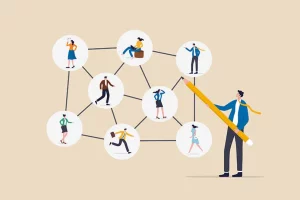
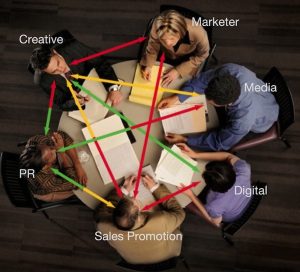
Collaboration works well for complex situations because the style of working collaboratively matches the nature of the issues that complex situations pose.
Complexity is unpredictable, and collaborating is adaptable; complexity is messy – it’s difficult to work out the question, let alone the answer – and collaborating involves bringing together a diversity of people and talents to improvise and test possible approaches, all learning as you go. Complexity offers unique and novel conundrums, and collaboration draws on a deep foundation of trust to that fosters creativity and delivers innovations.
The last domain of the Cynefin framework is chaos. This is where it’s impossible to discern a relationship between cause and effect. The best approach in this domain is simply to take action. Paradoxically it really doesn’t matter which group style is used here, as any way of working will either create opportunities in the complex space where collaboration can take effect, or push the situation into the simple domain where a co-ordination approach is effective.
With the Cynefin framework as a guide, we can better align the type of group work with the nature of the issue at hand. Collaboration is not the best approach in every situation and let’s not fall into the trap of thinking of it as a panacea. Sometimes it’s simply more effective to issue a direction to get the job done when the job is simple or complicated. It’s when things are truly complex that collaboration is most effective, and the reality is that the world is becoming more connected, faster moving and therefore more complex by the minute. Collaboration will have a growing role to play in every organisation.
References
[1] Economist Intelligence Unit (2008). The role of trust in business collaboration.
[2] Snowden, D. J. and M. E. Boone (2007). “A Leader’s Framework for Decision Making.” Harvard Business Review November.
This entry was posted in agency solutions, Evalu8ing - Relationship Performance Monitoring, interesting observations, marketing process optimisation, strategic management and tagged agency solutions, Anecdote, collaborate, Collaboration, cynefin, cynefin framework, Evalu8ing, marketing process optimisation, relationship performance, Shawn Callahan, strategic management. Bookmark the permalink.

Subscribe
Vimeo
Youtube
Facebook
Twitter
LinkedIn
RSS
Slideshare
Reviewed Books
Four Square
Google Maps
Google+