In the boardroom, process design is often treated as a sterile engineering exercise. Consultants are brought in to map out “idealised” workflows, drawing pristine boxes and arrows that represent how work should move through a marketing department. These flowcharts are then “enforced” on the team, bound in a digital PDF, and promptly ignored by the people actually doing the work.
The failure of traditional marketing process design lies in its top-down nature. It assumes that marketing is a linear assembly line when, in reality, it is a complex social system of collaboration.
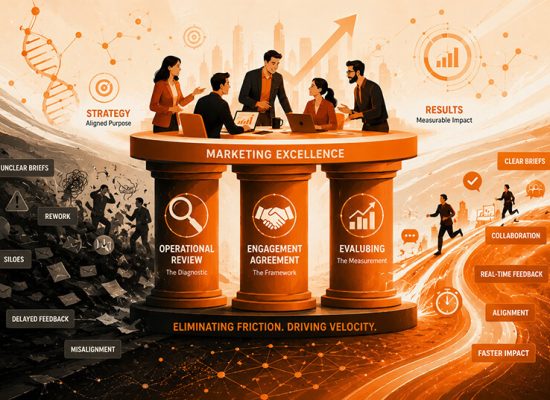
At TrinityP3, we have moved beyond static process mapping. Our Ways of Working (WoW) and Engagement Agreement methodology represents a superior approach because it prioritizes ownership over enforcement. By involving the people managing and delivering the process in its design, we create a living system that survives personnel changes and agency rotations.
1. The Flaw in “Enforced” Process Design
Too often, marketing processes are designed in a vacuum by external operations consultants or procurement leads who are disconnected from the daily creative friction of the brand. This leads to several systemic failures:
-
Resistance to Rigidness: When a process is “enforced,” teams find workarounds. If a briefing system is too cumbersome, people start briefing via WhatsApp or over coffee. The “official” process becomes a ghost ship—perfect on paper, but empty of actual activity.
-
The “New Broom” Syndrome: One of the biggest threats to marketing efficiency is the arrival of a new CMO or a new agency lead. Each “new broom” brings their own favorite templates and idiosyncratic ways of working. Without a documented and collectively owned framework, the existing process fragments instantly, and the organization loses years of institutional knowledge.
-
The Linear Trap: Traditional mapping often assumes a “Waterfall” approach (Step A must lead to Step B). In a modern, multi-channel environment, work is often concurrent and iterative. Static maps can’t handle the messiness of real-time collaboration.
2. The Power of Co-Creation and Ownership
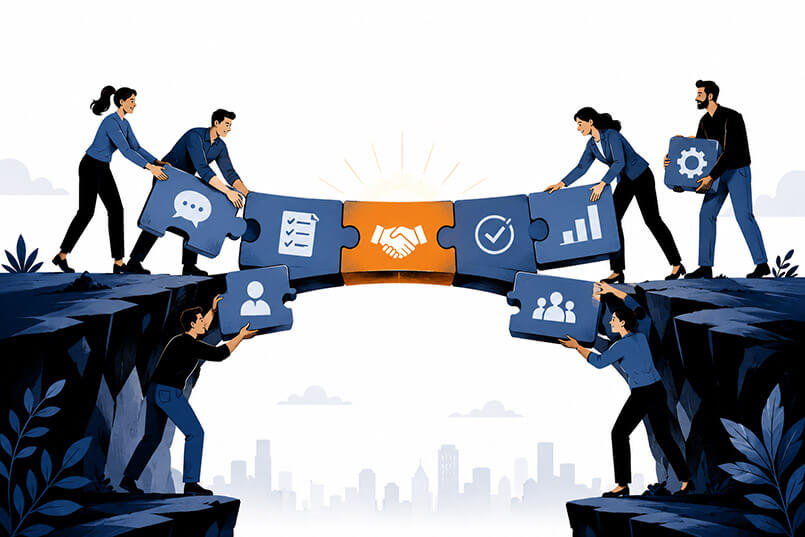
The Engagement Agreement methodology turns process design into a collaborative act. Instead of telling teams how to work, we facilitate a series of workshops where the marketing teams and their agencies design the interaction themselves.
Why Ownership Trumps Compliance
When a Brand Manager and a Creative Director sit in a room and agree on what a “Great Brief” looks like, they are no longer following a rule—they are upholding a promise. Because the people delivering the work helped build the framework, they have skin in the game.
This collaborative approach addresses the “why” before the “how.” When teams understand that a specific approval gate exists to protect them from legal risk or to ensure budget alignment, they stop seeing it as a hurdle and start seeing it as a safety net.
Multi-Directional Design
Unlike traditional mapping, which usually focuses on what the agency must deliver to the client, our methodology is multi-directional. It asks:
-
“What does the agency need from the client to be successful?”
-
“What are the non-negotiables for the media partner to hit their deadlines?”
-
“How does the internal legal team want to be engaged to prevent bottlenecks?”
3. Overcoming the Fragmentation of Change
One of the most powerful benefits of a documented Engagement Agreement is its ability to act as the Organizational Anchor.
Marketing departments are high-churn environments. Agencies come and go; marketing leads rotate every two to three years. In a traditional model, the process departs with the person. With a Ways of Working (WoW) Manual in place, the process belongs to the position, not the person.
Onboarding vs. Re-Inventing
When a new agency is appointed, they aren’t invited to bring their “proprietary process.” Instead, they are onboarded into the brand’s established Engagement Agreement. They are shown: “This is how we brief, this is how we provide feedback, and this is how we measure success here.”
This doesn’t stifle the agency’s creativity; it focuses it. It removes the first six months of “feeling each other out” and replaces it with instant operational alignment. The benefit of an agreed-upon process is no longer fragile—it is foundational.
4. The Methodology: A Living, Breathing System
Traditional process mapping is “set and forget.” An Engagement Agreement is reviewed collectively and regularly improved.
The Feedback Loop
By using tools like Evalu8ing alongside the Engagement Agreement, we create a continuous improvement loop. If the data shows that the “Feedback Cycle” is still a point of friction despite the agreed-upon rules, the team reconvenes to adjust the process.
This creates a dynamic process that evolves as the business grows. If the brand shifts from traditional media to a social-first “Agile” model, the Engagement Agreement is updated by the team to reflect those new requirements.
5. The Superiority of Engagement
The difference between traditional process design and the TrinityP3 Engagement Agreement approach is the difference between a Map and a Compass.
A map tells you exactly where to step, but it becomes useless the moment the terrain changes. A compass gives you a direction and a set of principles that allow you to navigate even when the path is blocked.
By prioritizing ownership, co-creation, and multi-directional accountability, we help marketing organizations build a Collaborative Operating System that:
-
Survives leadership and agency turnover.
-
Reduces the friction and “noise” of daily interactions.
-
Empowers the people doing the work to improve the system they use.
Fix the Interaction, Not Just the Map
Stop enforcing processes on people who didn’t help build them. If you want a high-performing marketing team, you must involve them in the design of their own success.
The Engagement Agreement methodology isn’t just about drawing better boxes and arrows; it’s about building a culture of mutual respect and operational excellence that stands the test of time.