
In the current marketing landscape, “complexity” is the word of the decade. Marketers are juggling expanded agency rosters, integrating burgeoning in-house capabilities, and navigating a relentless demand for “real-time” content. Yet, despite the sophisticated tech stacks and high-priced talent, many organizations feel like they are wading through treacle.
The traditional response to underperformance is usually a structural “pivot”: we pitch the agency, we restructure the department, or we hire a new CMO. But these are often cosmetic fixes for a systemic disease.
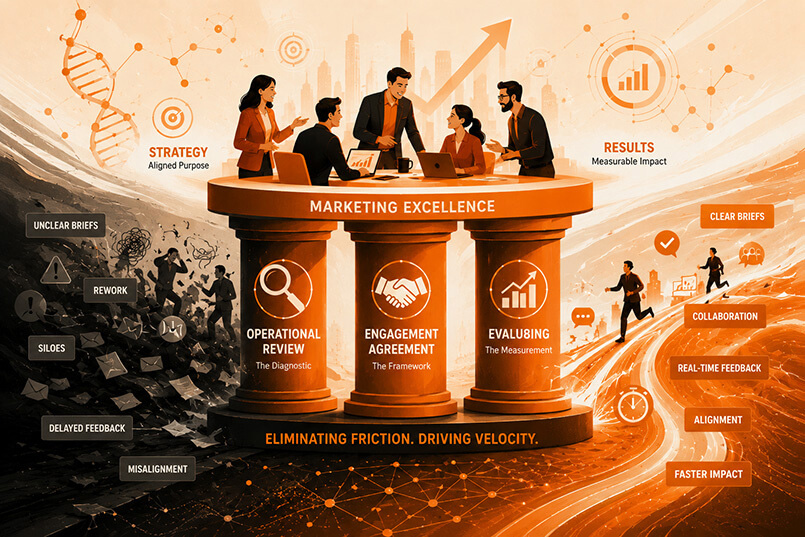
At TrinityP3, we have identified that true marketing excellence—whether delivered by an external agency or an internal resource—is built on three interdependent pillars: The Operational Review (The Diagnostic), The Engagement Agreement (The Framework), and Evalu8ing (The Measurement).
When balanced correctly, this trinity eliminates the “friction costs” that drain up to 20% of marketing productivity and replaces them with a culture of mutual accountability.
1. The Operational Review: Auditing the “Why” and the “How”
The first pillar is the Agency Operational Review. This is the deep-dive diagnostic designed to uncover the structural truths of the relationship. Most organizations wait until a relationship is in crisis to perform a review, but high-performing teams use them as a proactive “health check.”
Beyond the Output
Traditional audits look at the “What”—the quality of the TVC or the ROI of the media spend. An Operational Review looks at the “How.” We examine the mechanics of the collaboration:
-
The Briefing Flow: Is work starting with a clear strategy, or is the agency “briefing themselves” through trial and error?
-
Approval Hierarchies: How many layers of “Maybe” must a project pass through before it reaches a “Yes”?
-
Resource Mapping: Are the right seniority levels being applied to the right tasks?
The In-House Parallel
For in-house agencies, the Operational Review is often a wake-up call. Internal clients often treat in-house resources as “free” or “unlimited,” leading to a chaotic intake process that prioritises urgency over importance. The review identifies these systemic leaks, providing the data needed to move from a “production shop” to a “strategic hub.”
2. The Engagement Agreement: Defining the “Ways of Working” (WoW)
If the Operational Review identifies the gaps, the Engagement Agreement (EA) is the bridge built to close them.
For too long, the industry has relied on the Service Level Agreement (SLA). The problem with an SLA is that it is a legal document designed for “compliance.” It tells the agency what happens if they fail. An Engagement Agreement, conversely, is an operational document designed for “success.” It tells both parties how to win.
The Multi-Directional Contract
The EA is built on the realisation that the client’s behaviour directly impacts the agency’s performance. It formalises the “Ways of Working” (WoW) for both external partners and internal teams:
-
Mutual Commitments: The agency commits to strategic leadership; the client commits to consolidated, actionable feedback within 48 hours.
-
Process Standardisation: Explicitly defining the “Definition of Ready”, the minimum information required for a brief to be accepted.
-
Conflict Resolution: Setting the protocols for “respectful challenge,” ensuring that creative friction leads to better ideas rather than fractured relationships.
For an in-house team, the EA acts as an Internal Charter. It gives the internal agency the mandate to push back on poor briefs and establishes a “contractual” relationship with business units, ensuring the internal team is respected as a professional partner.
3. Evalu8ing: The Measurement of Collaborative Health
The final pillar is Evalu8ing, TrinityP3’s proprietary relationship diagnostic platform. Without measurement, the Engagement Agreement is merely a “wish list.” Evalu8ing turns the “soft skills” of collaboration into hard data.
Measuring the “White Space”
Evalu8ing moves beyond the one-way “report card” where a client marks their agency. It is a 360-degree, multi-directional assessment.
-
Agency-to-Client: Allows the agency to provide honest, anonymous feedback on the quality of the client’s briefing and leadership.
-
Agency-to-Agency: In a multi-agency roster, it measures how well the Creative, Media, and Digital partners are collaborating.
-
Internal Stakeholder Alignment: Measures how well different internal divisions (Marketing vs. Sales vs. IT) are aligned on the brand’s goals.
Continuous Improvement
By running Evalu8ing as a quarterly pulse check, organizations can see if the “Ways of Working” established in the Engagement Agreement are actually being followed. It identifies “micro-frictions” before they turn into relationship-ending crises. It provides the C-suite with a “Health Score” for their marketing investments, proving that the team is becoming more efficient over time.
The Velocity Dividend: Balancing the Trinity
Why does this balance matter? Because speed requires structure. When you undertake an Operational Review, you identify where you are losing time. When you implement an Engagement Agreement, you set the rules that recover that time. When you use Evalu8ing, you ensure that those rules are being respected.
The result is what we call the Velocity Dividend.
-
Externally: You stop the “Pitch Cycle.” You fix the relationship you have, saving the massive cost and disruption of going to market.
-
Internally: You empower your in-house teams. You give them the structure they need to produce high-quality work without the burnout.
-
Commercially: You ensure that every dollar of fee—whether paid to a global network or an internal headcount, is focused on outputs and outcomes, not on navigating internal bureaucracy.
Engineering the “Dream Team”
High-performing teams are not an accident of chemistry; they are an achievement of architecture.
By balancing these three elements, you move your marketing department from a state of “reactive chaos” to “proactive excellence.” You stop policing your partners and start enabling them. Whether you are managing a roster of ten global agencies or an internal team of fifty, the path to performance is the same: Audit the process, Agree on the behaviour, and Measure the collaboration.