
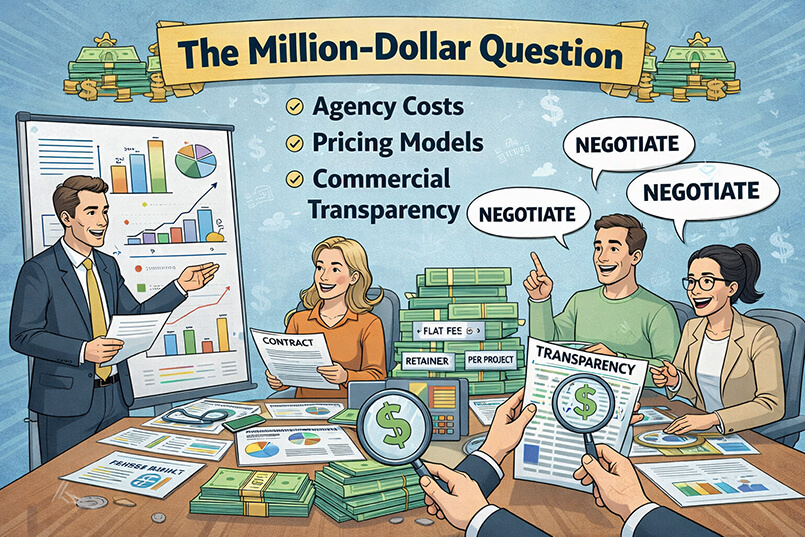
How Much Does a Marketing Agency Cost?
This is arguably the most common and complex question any marketer or procurement professional asks during an agency selection process: “How much does a marketing agency cost these days?”
The straightforward answer is that there isn’t a straightforward one. Providing a single number could be misleading because agency costs depend on many interconnected factors. It’s more about strategic negotiation of value, volume, and scope than about a fixed-price list.
At TrinityP3, we consider the commercial negotiation (which corresponds to Step 6: Brief on Scope and Negotiate Commercials in our 7-Step Agency Selection Methodology) a crucial phase in which you turn strategic intent into tangible commercial value. This article explores the complex factors that influence agency fees, clarifies the key differences among pricing models, and offers a framework for marketers to achieve transparency and value for money.
The Core Variables Determining Agency Cost
The cost of a marketing agency is highly dynamic, influenced by three primary factors that dictate their perceived value and required resources.
1. Reputation and Positioning in the Market
“How will you measure the success of our first 12 months together, and what is your specific, accountable commitment to the successful outcome defined in our brief?”
An agency’s fee is intrinsically linked to its brand equity and market positioning.
- Premium/Tier 1 Agencies: These are often globally recognised networks (e.g., WPP, Publicis, Omnicom groups) or highly sought-after, award-winning independent agencies. They command premium rates because of their perceived access to top-tier talent, specialised resources (e.g., advanced data science and proprietary tools), and proven track records with large, complex accounts. You are paying a premium for the assurance and status linked to their brand.
- Mid-Tier Agencies: These agencies provide a good balance of capability, talent, and competitiveness. They usually have strong strategic leadership and extensive domain expertise, but may run with lower operational costs than Tier 1 counterparts. They offer great value for money when the scope is clearly outlined.
Specialist/Boutique Agencies: These firms focus on niches (e.g., highly specialised B2B content, advanced programmatic media, niche cultural insights). While their overall retainer may be lower, their specialist hourly rate might be high due to the scarcity of their expertise.
2. Complexity and Volume of the Scope of Work (SOW)
The sheer scale and intricacy of the work required directly affect the resources—and thus the cost—that an agency must dedicate.
- Complexity: A complex SOW involves multiple channels, sophisticated data integration, global or multi-market coordination, and extensive strategic planning. Highly complex work requires more senior, expensive talent, increasing the overall fee.
- Volume and Economies of Scale: A large volume of predictable, repeatable work (e.g., high-volume asset localisation, standardised reporting) allows the agency to staff efficiently and potentially leverage offshore resources. A larger, stable retainer often results in a lower effective hourly rate than a series of smaller, unpredictable projects. Economies of scale are achievable when the client provides clear planning and commitment.
Talent seniority: The ratio of senior to junior staff needed is a key cost factor. A strategic retainer prioritising Chief Strategy Officers and Planning Directors will be considerably more costly than an execution-focused retainer centred on Production Managers and Account Executives.
3. Pricing Model (The Contractual Structure)
The way the services are contracted fundamentally changes the answer to “how much does it cost?” The industry generally operates on three primary models: Project-Based, Retainer/FTE, and Output/Value Pricing.
The Three Primary Agency Pricing Models
Marketers must clearly define which model best suits their operational needs, as each demands a different level of commercial transparency and management.
1. Retainer or Full-Time Equivalent (FTE) Pricing
This model offers a fixed monthly fee in exchange for a defined set of dedicated resources or a specified number of full-time equivalents (FTEs).
- How it works: The agency assigns specific individuals and roles (e.g., 0.5 Strategy Director, 1.0 Account Manager, 0.7 Creative Director) to the client’s business for a contractual period (usually a multiple of 12 months).
- When to Use It: Perfect for stable, high-volume workloads that need consistent team collaboration and proactive planning (e.g., ongoing brand maintenance, content creation, continuous media optimisation).
- Commercial Risk: The client risks paying for underutilised time if the workload varies; the agency risks absorbing unbilled overtime during busy periods.
Key Requirement: Mandates the client to perform thorough timesheet auditing to confirm the contracted hours and seniority levels are being met.
2. Output or Project-Based Pricing
This model assigns a fixed fee for a specific, defined deliverable or project.
- How it Works: The agency sets a fixed price for a defined SOW (e.g., “Develop three 30-second TVCs and six social cut-downs”), regardless of the actual time taken. This price is usually based on the agency’s internal costs (including time, resources, and overhead) plus a margin.
- When to Use It: Ideal for specific, one-time deliverables with clear limits (e.g., annual reports, particular campaign production, new logo design).
- Commercial Risk: If the client alters the brief (scope creep), costs can escalate rapidly. The agency is motivated to reduce hours to boost profit margins.
Key Requirement: Demands highly disciplined management of the Scope of Work (SOW) and strict change order procedures.
3. Defined Budget Approach (The Inverse Negotiation)
This approach is fundamentally different and is often employed for defined projects with fixed, non-negotiable budget caps.
- How it Works: The client states the fixed budget upfront (e.g., “We have $500,000 for this digital brand campaign”) and asks the agency to define the maximum volume, quality, and scope of work they can deliver for that amount.
- When to Use It: Ideal for situations where the budget is set by finance, or for smaller project-based tasks focusing on maximising output within financial limits.
- Commercial Risk: The client risks sacrificing quality or ambition for volume; the agency risks being seen as “low quality” if they need to significantly scale back the scope to meet the budget.
- Key Requirement: The agency must provide a transparent breakdown of the SOW they can deliver within the budget, enabling the client to assess the trade-offs (e.g., fewer videos, less senior talent, reduced media spend).
Achieving Commercial Transparency
Whatever model you choose, the key to controlling agency costs is commercial transparency, which is the focus of Step 6 in our methodology. You need to go beyond just the final figure and understand what makes up the fee.
The TrinityP3 Commercial Negotiation Checklist
When reviewing fee proposals, demand the following elements:
- Staffing Plan Alignment: Confirm that the roles, names, and seniority levels in the fee proposal (Section 6 of the RFP) align with the team outlined and the SOW required. This directly addresses the Commercial Transparency Question (Question 7 in our 7-Questions article).
- Fully Burdened Rates: Request the agency’s fully burdened hourly rates (FBRs). This figure includes salary, overheads (rent, software, utilities), and profit margin. Understanding the FBR enables you to compare costs with industry standards.
- Benchmarking: Utilise independent, specialised resources (such as TrinityP3’s commercial benchmarking data) to evaluate whether the proposed hourly rates and FTE allocations are fair, competitive, and sustainable.
- No Hidden Costs: Ensure transparency on all third-party charges, mark-ups, and technology fees. All commercial terms must be clearly specified.
The answer to the million-dollar question
The question, “How much does a marketing agency cost?” is an opportunity, not an obstacle. It compels the marketer to define the specific value they anticipate receiving clearly.
Agency fees are complicated, influenced by their reputation, the complexity and size of the SOW, and the chosen pricing model (Retainer, Project, or Fixed Budget). The primary responsibilities of the marketing and procurement teams are to navigate this complexity by demanding transparency in commercial terms and using structured benchmarking.
By clearly defining the desired successful outcome (Step 1), rigorously outlining the Scope of Work, and insisting on a transparent breakdown of the proposed fee (Step 6), you shift the focus from paying a price to investing in a measurable, value-based partnership.
The cost of an agency isn’t just what they charge; it’s what they deliver in relation to your strategic business objectives.