
If you’ve read the WARC Future of Strategy report, you’ll know we are currently living through a bizarre paradox. Eighty per cent of strategists believe their discipline is at a crossroads, and over sixty per cent feel that strategy is now treated as an expendable line item when budgets get tight. Yet, in the same breath, marketers are screaming for clear strategic guidance to navigate a world that feels increasingly like a permanent state of chaos.
So, why the disconnect? Why is the thing marketers say they want most – transformative strategy – also the very thing being devalued in the procurement process?
As a consultant who sits in the middle of these agency-marketer selection processes, I believe the answer lies in the way we’ve allowed “data” to become a mask for a lack of genuine insight. We’ve turned the pitch process into a battle of the black boxes. We’ve let agencies hide behind “proprietary tools,” “AI-enabled sentiment engines,” and “deep-dive data stacks” that are designed more to obscure the agency’s thinking than to reveal it.
The result?
Marketers find it almost impossible to test an agency’s true strategic capability. They are essentially being asked to bet on which agency has the shiniest toy, rather than which agency has the best people.
The traditional pitch is an arms race of data acquisition. Agencies spend thousands of dollars and hundreds of hours trying to prove they have “secret” information about your brand that you don’t. They present slides filled with complex graphs and “unique methodologies” that look impressive but often boil down to the same old platitudes wrapped in new jargon.
This is what I call the “Black Box Problem.” When an agency uses its own proprietary tracker or a closed-loop AI tool to develop a strategy, you aren’t testing their thinking; you’re testing their access. You have no way of knowing if the “insight” they’ve found is a genuine strategic leap or just an automated output from a piece of software.
This obfuscation has devalued strategy because it has made it feel like a commodity. If the “tool” does the work, why pay for the “brain”? This is exactly what the WARC report warns – the risk that we are hiding behind mountains of research and losing our point of view.
The TrinityP3 Workshop offers a level playing field.
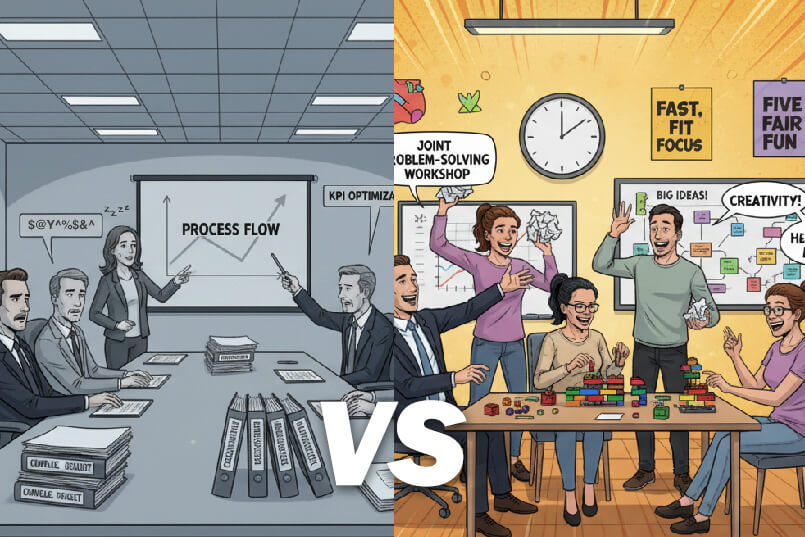
At TrinityP3, we’ve always advocated for the “Strategy Workshop” as the critical step in any agency selection. It’s Step 5 of our methodology for a reason: it is like a test drive, it moves the focus from “the promise” to “the proof.” But even a workshop can be gamed if we aren’t careful.
So, here is a provocative thought for every marketer looking to hire a strategic partner: Stop asking agencies to bring their own data. Imagine a pitch process where the strategic workshop is no longer a test of who has the biggest research budget. Instead, imagine if the client provided all three shortlisted agencies with access to the same live, continuous brand tracking platform – specifically, Tracksuit.
By giving every agency, the keys to the client’s actual category data, customer segments, and brand health metrics on Tracksuit, you do something radical. You eliminate the obfuscation. You take the “stove” out of the equation and focus entirely on the “chef.”
Time to test the brain, not the box.
When every agency is looking at the exact same dashboard, the “what” is no longer the variable. Everyone can see that consideration in the 18-24 demographic is dipping. Everyone can see that a competitor is gaining ground on “innovation” perceptions.
The real test, in fact the only test that matters, is what the agency does with that information.
In this structured workshop environment, the marketer gets to see the raw, unvarnished strategic capability of the team. You get to watch as they filter the Tracksuit data, cross-reference it with media consumption habits, and search for the “Why” behind the “What.”
- Agency A might look at the data and see a need for a massive reach campaign to fix awareness.
- Agency B might dive deeper into the imagery tab and realise the problem isn’t awareness, but a misalignment between brand values and actual customer perception.
- Agency C might find a hidden “white space” segment that the brand is accidentally appealing to and suggest a pivot that could unlock millions in new revenue.
Suddenly, you are not judging a deck. You are judging actionable strategic and creative thinking. You are assessing their ability to take a common source of truth and turn it into a strategy that actually drives business value.
Can this leave to revaluing the “Strategic Leap”?
The WARC report highlights a fear that AI will eventually learn to take the “strategic leaps” that have traditionally been the domain of humans. I disagree. AI can find the patterns, but it cannot find the meaning.
By using a platform like Tracksuit in a pitch workshop, you are forcing agencies to perform those human leaps in front of you. Tracksuit’s design is excellent precisely because it doesn’t try to be a black box; it’s an open window. It presents the data with such clarity and simplicity that it actually demands more from the strategist. You can’t hide behind a “jargon-filled PDF report” when the client is looking at the same intuitive dashboard you are.
This approach puts the strategist back in the spotlight. It revalues the discipline because it proves that two different teams can look at the same data and arrive at vastly different outcomes, one of which will be significantly more effective than the others. That difference is the “value” of strategy. That difference is what you are actually hiring.
A Call to Action for Marketer
The era of buying “proprietary insights” is over. In a world where data is democratised and AI is ubiquitous, the only remaining competitive advantage is the quality of your agency’s thinking.
If you are running a tender this year, I challenge you to change the rules. Don’t ask for a “strategic response” based on their research. Hand them the keys to your brand tracker. Give them the same level playing field. And then watch closely.
If an agency complains that they “need their own tools” to be effective, they are telling you they are a software reseller, not a strategic partner. The best agencies, the ones with the enquiring minds and the “marketing sherpas” described by WARC, will relish the challenge. They will love the fact that they don’t have to waste time gathering data and can spend every minute of the workshop proving why their brains are the best investment you’ll ever make.
Strategy isn’t devalued because it’s no longer needed. It’s devalued because we’ve stopped testing it properly. It’s time to bring it back into the light.