

Changing agencies is the most common lever marketers pull to address underperforming campaigns, yet most pitch processes fail to solve the underlying problem. Traditional Request for Proposals (RFPs) evaluate creative chemistry and speculative ideas rather than operational measurement rigor. An effectiveness-led RFP transforms the agency pitch into a diagnostic audit, testing a prospective partner’s ability to measure incremental financial returns, navigate commercial metrics, and enforce briefing discipline before contracts are signed.
1. The Pitch Fallacy: Why Changing Agencies Rarely Fixes Performance
When market share stalls, marketing dashboards look weak, and executive pressure mounts, the default reaction across the C-suite is predictable: fire the agency and put the account out to tender.
At TrinityP3, having managed hundreds of agency pitches globally, we see this cycle constantly. The pitch process begins with high enthusiasm. Agencies present slick speculative work, showcase their best-case studies, and promise breakthrough creative thinking. A winner is selected, contracts are signed, and a honeymoon period ensues.
Yet, 18 months later, the business often finds itself back at square one, facing the exact same measurement ambiguity, budget friction, and lack of proven ROI.
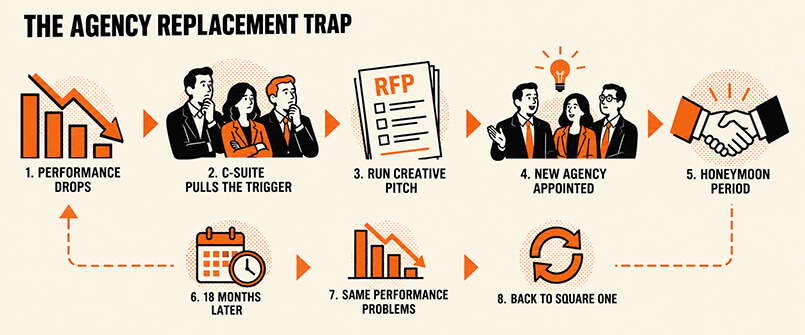
Why does this happen? Because a traditional pitch process measures agency chemistry, not commercial capability.
If your internal measurement architecture is weak, your briefing process is unstructured, or your KPIs prioritize vanity digital metrics over commercial profitability, swapping agency partners is merely treating a symptom. To find a partner capable of moving the commercial needle, you must redesign your pitch process to audit how an agency measures, evaluates, and optimizes real business value.
2. Redesigning the RFP: Traditional vs. Effectiveness-Led Procurement
Most agency RFPs contain standard, low-value questions: “Show us your best creative case studies,” “What is your team structure?” or “What are your hourly rates?”
An effectiveness-led RFP replaces vague inquiries with direct, structural challenges designed to reveal whether an agency understands financial accountability.
| RFP Evaluation Category | Traditional Pitch Focus (Creative Theatre) | Effectiveness-Led Pitch Focus (Commercial Alignment) |
|---|---|---|
| Measurement Strategy | “How do you track campaign impressions and engagement?” | “How do you isolate incremental margin lift from baseline organic sales?” |
| KPI Frameworks | “What tools do you use for digital performance reporting?” | “How do your tactical optimization metrics connect to our CFO’s P&L targets?” |
| Briefing & Scope | “How fast can your team turn around campaign requests?” | “What is your methodology for pushing back on low-impact, ad-hoc briefing requests?” |
| Data Architecture | “Can you integrate with our Google Analytics and ad accounts?” | “How do you resolve attribution decay, privacy changes, and data discrepancies?” |
| Commercial Contract | Retainer fee based on headcount or percentage of media spend. | Base fee + performance incentive tied to independently verified commercial outcomes. |
3. The 4-Step Agency Measurement Audit
To evaluate an agency’s true ROI capability during an RFP process, structure your evaluation stage around four practical diagnostic tests.
Step 1: Audit Measurement Philosophy (Incrementality vs. Attribution)
Last-touch attribution models are notoriously inaccurate, taking full credit for prospective customers who would have purchased anyway.
- The Pitch Test: Give participating agencies historical campaign data containing standard digital attribution results. Ask them: “Identify which portions of this revenue represent true incremental growth versus baseline organic demand and explain how you would design a holdout test to prove it.”
- What to look for: Beware of agencies that rely entirely on platform-reported ROAS (Return on Ad Spend). Look for partners that talk openly about Marketing Mix Modelling (MMM), matched-market testing, and geo-lift experiments.
Step 2: Test Data Architecture & Analytics Rigor
Many agencies claim advanced analytics capability but actually rely on out-of-the-box automated dashboard tools that simply aggregate surface-level metrics.
- The Pitch Test: Require the agency’s senior analytics lead, not their pitch team or business development head, to present a live walkthrough of how they construct a commercial reporting hierarchy.
- What to look for: The agency should clearly demonstrate how top-of-funnel operational metrics (CPCs, CTRs) feed mid-funnel diagnostic health (CPA, CVR) and ultimately link to bottom-line commercial metrics (CLV, Net Retention, Incremental Profit).
Step 3: Evaluate Prioritisation & Briefing Discipline
An agency that blindly accepts every brief you send them is not a strategic partner; they are an execution vendor. The best agencies protect your budget by challenging low-impact requests.
- The Pitch Test: Present participating agencies with three sample project briefs – two high-effort/low-impact tactical requests, and one complex strategic brief. Ask them to prioritize the workload using a capacity matrix.
- What to look for: Outstanding agencies will actively decline or recommend restructuring the low-impact briefs, presenting clear commercial logic for why those resources should be reallocated to high-impact activities.
Step 4: Structure Effectiveness-Led Commercial Contracts
If an agency’s fee structure is purely tied to a percentage of media spend, they are financially incentivized to recommend larger media budgets regardless of effectiveness. If they are paid purely on billable hours, they are incentivized to work slowly.
- The Pitch Test: Ask participating agencies to submit a commercial remuneration proposal that includes a performance-incentive component linked directly to verified commercial metrics.
- What to look for: Look for agencies willing to put a portion of their profit margin at risk in exchange for upside bonuses tied to agreed business outcomes (e.g., market share growth or net customer margin).
- Setting the Foundation Before You Issue the RFP
Before launching an agency tender, your internal marketing organization must establish its own baseline measurement governance. Asking an agency to prove ROI when your internal team cannot define its financial KPIs only creates confusion.
Before issuing your next RFP, complete these three internal preparation steps:
- Define Your Commercial North Star: Agree with your CFO on the exact 1–2 financial metrics (e.g., CAC payback target, incremental margin) that will define success.
- Audit Internal Capacity: Identify whether performance bottlenecks stem from agency execution or internal operational overload.
- Establish Clear Pitch Criteria: Ensure your RFP evaluation panel includes team members capable of assessing data infrastructure, financial modelling, and commercial governance – not just creative work.
Pitching a New Agency Won’t Fix a Flawed Strategy
A tender can bring fresh creative thinking, but if your measurement framework and commercial governance are broken, a new agency will not solve the underlying performance issue.
Before you invest months of time, money, and energy into an agency search, make sure your marketing function is structured for true commercial effectiveness.
Planning an agency pitch? Contact us to discuss your objectives and requirements here. But first, evaluate your marketing effectiveness performancewith the 3-Minute TrinityP3 Marketing Effectiveness Self-Assessment here.
FAQs
An effectiveness-led agency RFP should include requirements for proving incremental lift (rather than relying on platform-reported attribution), establishing a multi-tiered measurement hierarchy, defining data governance protocols, and outlining methodologies for matched-market or holdout testing.
Rather than relying on polished case studies, evaluate an agency’s ROI capability by giving them raw historical campaign data and asking them to isolate baseline demand from incremental sales. Ensure their analytics leaders—not just their account managers—present their methodology for connecting campaign data to executive financial metrics.
Yes. A modern agency contract should ideally move away from pure billable hours or percentage-of-media-spend models. A balanced commercial agreement combines a fair base fee covering operational delivery with a performance bonus linked to verified commercial outcomes, such as incremental revenue, market share expansion, or customer lifetime value targets.
Initiating an agency pitch is the wrong lever if performance failures stem from internal organizational issues—such as a lack of clear commercial KPIs, an absence of brief prioritisation, or fragmented internal reporting. Firing an agency without fixing your internal measurement framework only leads to repeating the same 18-month cycle with a new partner. Internal measurement governance and strategic priorities must be established before going to market.
To keep a pitch focused on commercial value rather than speculative theater, replace generic creative assignments with real-world business challenges. Require participating agencies to demonstrate their measurement infrastructure, analytics capability, and brief-challenging discipline during early evaluation stages. Weight commercial alignment and data governance equally alongside creative execution in your final scoring matrix.