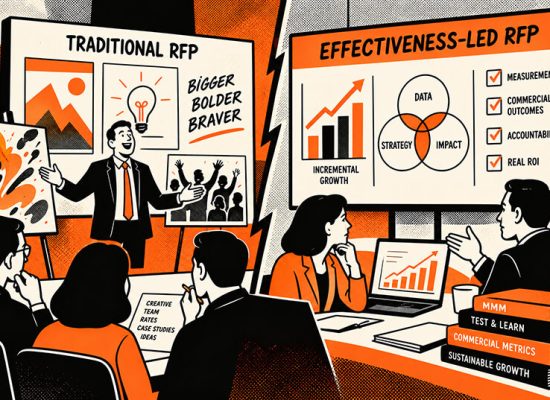

Marketing efficiency measures the speed and cost of executing tactical activities, whereas marketing effectiveness measures the commercial impact and business growth generated by those activities. When mismanaged, optimizing purely for efficiency drives down short-term acquisition costs while quietly eroding long-term market share, pricing power, and net return on investment.
1. The Efficiency Trap: Why Optimization Is Not Strategy
In an economic climate defined by tightening budgets and executive scrutiny, corporate leadership routinely challenges marketing departments to “do more with less.”
To satisfy executive demands, marketing teams turn to digital performance dashboards and begin optimizing for speed and unit cost reduction. They cut brand awareness campaigns, slash long-term media investments, and reallocate every available dollar into low-cost performance tactics.
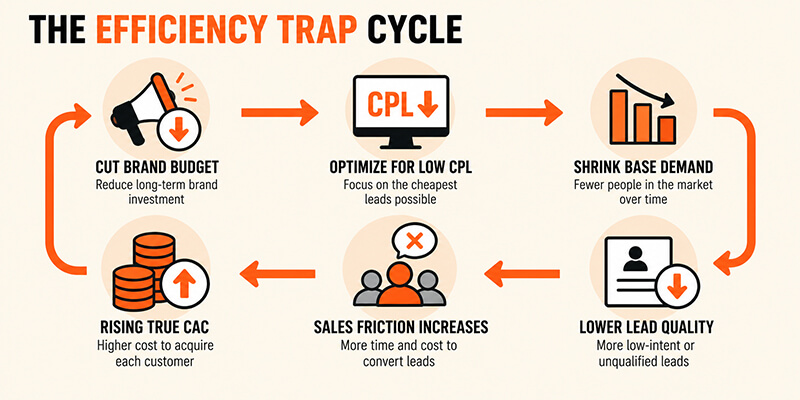
This is The Efficiency Trap.
Efficiency and effectiveness are not interchangeable terms:
- Efficiency is an operational metric focused on inputs. It asks: How cheaply and quickly can we generate a digital response?
- Effectiveness is a commercial outcome focused on business results. It asks: Are our marketing investments expanding net profit margin, market share, and enterprise value?
Blindly chasing efficiency kills effectiveness. When teams are incentivized to reduce cost-per-click (CPC) or cost-per-lead (CPL), they end up optimizing for low-cost operational output rather than commercial impact. Delivering 10,000 cheap leads that fail to convert into profitable, long-term customers is not efficient – it is an expensive operational drain.
2. The Anatomy of Flawed Metrics: Why Cost-Per-Lead (CPL) Lies to You
Of all the metrics monitored by digital marketing teams, Cost-Per-Lead (CPL) is among the most deceptive when used as a primary indicator of marketing success.
Digital platforms (such as Meta, Google, and LinkedIn) are designed to deliver precisely what you optimize for. If you set your campaign objective to minimize CPL, the ad algorithms will scan user networks to find the cheapest possible audience members willing to fill out a form or click a link.
However, the cheapest audience members to acquire are rarely the buyers who generate long-term commercial value.
What Happens When You Optimize Exclusively for Low CPL:
- Audience Degradation: Algorithms target low-intent users, contest-seekers, or price-sensitive shoppers who convert cheaply on top-of-funnel forms but lack buying authority or budget.
- Downstream Sales Friction: Sales teams spend hundreds of hours attempting to contact, qualify, and chase low-quality leads, inflating sales overhead and reducing pipeline velocity.
- Reduced Customer Lifetime Value (CLV): Customers acquired through heavy price-discounting or aggressive short-term efficiency offers display significantly higher churn rates and lower expansion potential.
Metric Comparison: Short-Term Efficiency vs. Long-Term Effectiveness
| Strategic Vector | Efficiency Focus (CPL Optimization) | Effectiveness Focus (Commercial ROI) |
|---|---|---|
| Primary Metric | Cost-Per-Lead (CPL), Cost-Per-Click (CPC) | Net Margin, Customer Lifetime Value (CLV), CAC Payback |
| Target Audience | Easiest/cheapest audience to convert online | High-intent, high-margin strategic buyer segments |
| Sales Impact | High lead volume; low conversion; sales fatigue | Qualified pipeline; higher win rates; faster deal cycles |
| Pricing Power | Forces price discounting and tactical promotions | Builds brand equity, mental availability, and price inelasticity |
| Commercial Health | Apparent short-term gains; long-term revenue erosion | Sustainable market share growth and margin expansion |
3. The Empirical Cost: How Short-Term Efficiency Cuts Erode Market Share
The fundamental error in performance-only marketing strategies lies in ignoring how brand equity drives commercial baseline sales.
Research in marketing effectiveness demonstrates that business growth relies on balancing two distinct mechanisms: Brand Building (creating mental availability and broad reach over long horizons) and Performance Activation (capturing immediate intent).
When marketing leaders cut brand building to maximize short-term efficiency metrics, they trigger a predictable decay pattern:
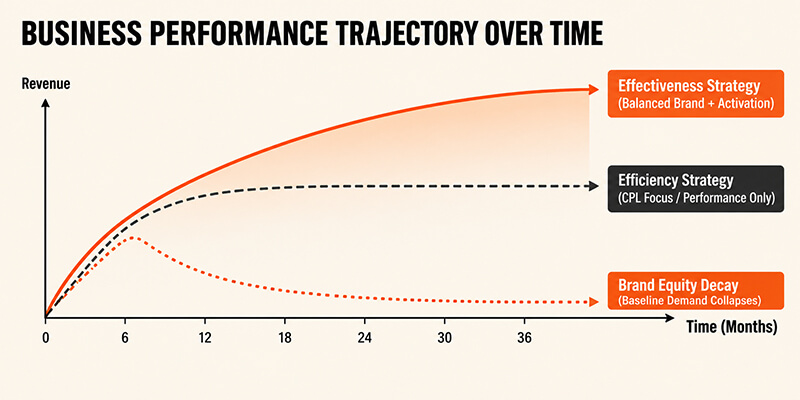
1. The Short-Term Illusion (Months 0–6)
Reallocating brand budgets into performance channels causes an immediate, apparent spike in efficiency. CPL drops, lead volume surges, and quarterly dashboards look exceptional. Executive leadership believes the “do more with less” mandate is working.
2. The Baseline Collapse (Months 6–18)
Because brand building has stopped, the brand’s broad mental availability begins to decay. Fewer prospective buyers become familiar with the business before entering the purchasing cycle. Baseline organic demand drops.
3. The True CAC Surge (Months 18–36)
As out-of-market buyer awareness vanishes, performance channels run out of high-intent prospects to capture. To maintain lead volume, the media spend must be pushed harder against cold, indifferent audiences. CPL skyrockets, true Customer Acquisition Cost (CAC) rises, and net profitability collapses.
4. Re-engineering the Approach: From Cost Reduction to Capital Allocation
To break free from the trap of flawed efficiency metrics, marketing leaders must transition from treating marketing as a tactical expense to managing it as a capital investment portfolio.
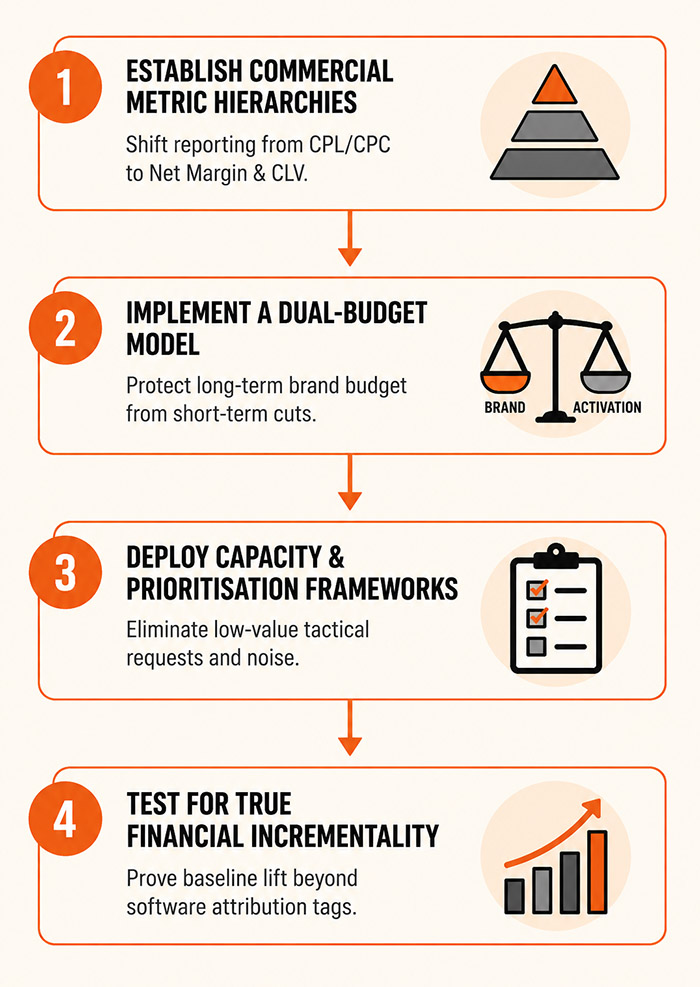
Step 1: Replace CPL with Incrementality and Margin KPIs
Stop evaluating campaign success based on digital form fills alone. Evaluate campaigns using Incremental Margin Return on Investment (IMROI) and CAC Payback Periods. Ask your finance team: Did this campaign produce additional revenue that would not have occurred organically?
Step 2: Implement a Dual-Budget Allocation Framework
Ring-fence your budget into two non-negotiable pots:
- Brand Building Pool (Long-Term Growth): Broad reach, broad targeting, emotional resonance, unconstrained by short-term CPL targets.
- Performance Activation Pool (Short-Term Capture): Tightly targeted campaigns evaluated on conversion efficiency and pipeline velocity.
Step 3: Use a Prioritisation Framework to Filter Noise
Overworked teams often resort to cheap efficiency tricks because they are drowning in ad-hoc requests. Implement an objective prioritisation matrix to score incoming work on commercial impact versus resource effort, allowing your team to eliminate high-effort/low-value activities.
Step 4: Test for True Financial Incrementality
Never assume digital tracking pixels are telling the full truth about ROI. Software attribution tags routinely claim credit for existing baseline demand—taking credit for customers who would have bought anyway. To prove true financial effectiveness to your CFO, deploy matched-market geo-testing, holdout groups, or Media Mix Modeling (MMM). By measuring sales generated over and above your un-marketed baseline demand, you prove true net financial lift rather than inflated platform metrics.
Stop Optimizing for Cheap Activity. Start Building Commercial Impact.
Chasing low CPLs and operational efficiency feels productive on a weekly performance dashboard, but it leaves your business vulnerable to long-term margin compression and brand decay.
If you are ready to stop reporting activity metrics and start building a measurement system aligned with true financial growth, take our rapid diagnostic assessment.
Where does your organization stand on the efficiency vs. effectiveness spectrum? Take the 3-Minute TrinityP3 Marketing Effectiveness Self-Assessment and find out. Or read more on our Marketing Effectiveness Advisory. Or contact us to discuss your marketing effectivness and measurement needs.
FAQs
Marketing efficiency focuses on operational speed and unit costs—such as reducing cost-per-click or generating more assets faster. Marketing effectiveness measures commercial outcomes—such as incremental net margin, revenue growth, customer retention, and market share gain. A campaign can be highly efficient (producing low-cost leads) while remaining completely ineffective (failing to drive real profit).
Cost-Per-Lead (CPL) measures only the initial unit cost of capturing user contact information; it does not account for lead quality, deal size, sales friction, or long-term retention. Optimizing strictly for low CPL encourages ad algorithms to target low-intent, price-sensitive audiences who convert cheaply on forms but rarely convert into profitable, long-term customers.
Focusing exclusively on short-term efficiency metrics leads to long-term performance decay. By starving brand-building campaigns to fund cheap direct-response activation, baseline consumer awareness collapses. Over 12 to 24 months, the pool of high-intent buyers shrinks, forcing performance ad costs to rise while total market share declines.
While optimal ratios vary by category (e.g., B2B vs. B2C enterprise), empirical research suggests a baseline benchmark of roughly 60% allocated to long-term brand building and 40% to short-term performance activation. Brand investments create broad mental availability and baseline demand, which prevents ad fatigue and makes your performance activation campaigns significantly more cost-effective over time.
Shift the conversation from top-of-funnel operational costs to bottom-line profitability. Demonstrate the downstream hidden costs of low CPLs—such as lower lead qualification rates, increased sales team fatigue, longer deal cycles, and lower Customer Lifetime Value (CLV). Present financial models that compare CPL against Incremental Margin and CAC Payback Periods to prove that “cheap” leads frequently cost the business more in net sales friction.