
Enterprise marketing operations consulting is frequently heralded as the definitive solution to bloated budgets, disconnected technology, and misaligned teams. Yet, many of these consulting engagements fail to deliver lasting, measurable value. The root cause is rarely a lack of strategic ambition. Instead, the failure almost always comes down to a lack of robust marketing operations governance.
Without a strong governance framework, operational transformation is temporary. Processes revert to their chaotic defaults, agency relationships remain unbalanced, and technology investments become expensive shelfware. For enterprise marketing leaders and procurement professionals, recognizing the pitfalls of poor governance is the first step toward genuine marketing process optimization.
Here are the nine core reasons enterprise marketing operations consulting engagements fail, and how enforcing governance can drive alignment, accountability, and commercial success.
1. Treating Procurement as a “Price Taker” Rather Than a “Value Creator”
One of the most persistent failures in marketing operations management is maintaining an outdated mandate for procurement. For decades, the standard Key Performance Indicator (KPI) for marketing procurement was a simple, easily quantifiable metric: savings achieved. This often involved aggressive negotiation of agency hourly rates, imposing steep discounts, or demanding across-the-board budget cuts. However, arbitrarily squeezing agency fees is a false economy. It forces agencies to compensate by using less experienced staff, reducing time dedicated to strategic planning, or cutting corners in production quality. The downstream failure results in poorly briefed, rushed work requiring multiple, expensive rounds of revision, chewing up valuable internal team time—the very definition of waste. Governance must shift procurement’s focus from mere price reduction to establishing the structural, commercial, and operational frameworks that guarantee maximum marketing effectiveness.
2. Lack of Transparency in the Digital Media Supply Chain
A lack of financial governance over media buying is a massive vulnerability. The modern digital media supply chain can be incredibly murky, plagued by ad fraud, viewability issues, and hidden “black box” margins. Marketing operations consulting fails if it does not interrogate this supply chain to identify value leakage, such as undeclared agency trading desk margins, kickbacks, and arbitrage. Effective governance demands a transition to fully “disclosed” agreements, ensuring complete transparency over programmatic buys so that budgets go toward working media rather than hidden fees. Furthermore, it requires reviewing and updating media agency contracts to mandate transparency, direct access to trading desk data, and rigorous financial reconciliation.
3. Prioritizing Technology Over Operational Reality
Many enterprises attempt to solve operational challenges by simply recommending more technology or process. This leads to bloated marketing technology stacks with overlapping functionalities and poor adoption. An effective consulting engagement must provide vendor-neutral guidance to audit your current stack, eliminate redundancies, and select platforms that match your long-term business strategy. Governance ensures that technology serves the operational structure, rather than forcing the team to adapt to redundant software platforms.
4. Failing to Establish Sustainable KPIs and Accountability
Consulting engagements often end with a polished presentation, but organizations struggle to maintain momentum once the consultants leave. This failure occurs when there is a lack of ongoing accountability. To ensure that the results of your marketing transformation are sustainable, it is critical to establish clear governance models, updated KPIs, and robust capabilities training. This formalized governance keeps both internal and external teams accountable over time, preventing the business from reverting to old, inefficient habits. Instead of relying on traditional audits that just look backward to tell you how cheaply media was bought, updated KPIs should focus on diagnostic performance assessments that ensure media strategy drives actual Business ROI.
5. Ignoring the Unprecedented Risks of Artificial Intelligence
AI is rapidly becoming a focal point for organizations looking at how it can improve productivity and marketing operations. However, deploying AI without structural guardrails is a massive governance failure. Enterprises face unprecedented commercial and ethical risks introduced by Artificial Intelligence. Successful engagements must look beyond the hype and implement a blueprint for managing these risks. This includes supporting initiatives such as developing AI production guidelines that protect the brand while enhancing operational speed, without losing sight of the people and processes that make successful delivery possible.
6. Siloing Internal and External Effectiveness
A common reason for consulting engagement optimization failures is addressing only half of the equation. Marketing management consultancy must focus on development and optimization in two distinct areas: External Effectiveness and Internal Effectiveness. External Effectiveness involves optimizing the structural, operational, and commercial relationships between marketing teams and their media, creative, digital, PR, production, martech, and measurement partners. Internal Effectiveness requires working with marketing teams to optimize their internal processes and structures, including marketing technology stacks, agency management, marketing measurement frameworks, and marketing prioritisation. Governance must bridge both domains; optimizing an agency roster will fail if the internal workflow remains disconnected.
7. Underestimating Resistance to Change and Stakeholder Misalignment
Marketing operations transformation is highly disruptive. When consulting engagements ignore the human element of change, internal teams will actively resist new workflows. A robust governance strategy anticipates this friction and integrates stakeholder management and collaborative change-management frameworks to align internal teams and smooth operational transitions. Without governance to guide this transition, even the best operational roadmaps will fail to gain traction within the broader enterprise.
8. Applying a One-Size-Fits-All Approach to Global Operations
Global marketing operations present unique complexities. A major failure in consulting engagements is attempting to apply a single, rigid operational model across entirely different markets. Governance structures must be flexible enough to allow for localized execution while maintaining centralized strategic oversight. Effective consultants design clear, actionable roadmaps tailored to your organizational structure, technology stack, and commercial goals. They must also have experience successfully delivering complex international programmes across diverse regions like EMEA and APAC.
9. Relying on Biased Consulting Advice
Finally, transformation fails when the consulting engagement itself lacks independence. If a consultant has financial ties to specific martech vendors or agency networks, their advice is inherently compromised. True governance requires completely vendor-neutral guidance. By leveraging unique industry benchmarks and diagnostic tools, enterprises can objectively analyze their current capabilities and accurately map out their future-state requirements without the influence of hidden agendas. Acting as independent advisors allows consultants to help marketers truly take back control of their media ecosystem.
Taking the next step
Enterprise marketing challenges are complex, but they are entirely solvable with the right oversight. Marketing operations consulting can deliver incredible ROI, but only when it is anchored by rigorous governance. By mastering the principles of Purpose, People, and Process (P3), marketing and procurement managers can redefine their mandate, secure demonstrably greater value, and become the indispensable Value Architects necessary for resilient and high-performing marketing organisations. When governance improves alignment and accountability, measurable value inevitably follows.
Read more on marketing procurement advisory services here, or contact us to confidentially discuss your specific situation and requirements.
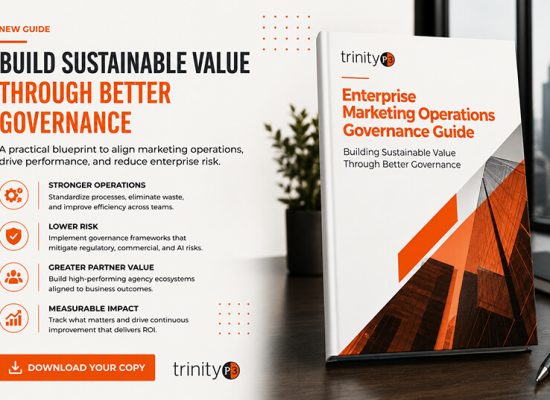
Download The Complete Guide to Marketing Operations Consulting & Governance, which provides a structural blueprint to fix operating model breakdowns, optimize marketing budgets, and select marketing operations consulting partners equipped to drive measurable, long-term performance.
Fill out the form below to download your complimentary copy: