
A New Strategic Blueprint for Marketing Procurement: How to Pivot from Price Taker to Value Architect
The marketing procurement function is at a pivotal crossroads. For years, the mantra of “cost savings” has driven every decision, turning procurement managers into tactical executioners obsessed with the lowest hourly rate. But if your team is struggling with endless rework, strained agency relationships, and campaigns that fail to deliver, you are likely trapped in a costly illusion: the False Economy.
The truth is, traditional cost-cutting in marketing is often the single most significant driver of systemic waste. Squeezing agency fees forces them to cut corners—less experienced staff, less strategic thinking, and compromised production quality. The initial 5% saved is instantly overshadowed by the 20% wasted on internal time spent correcting a poorly executed brief or a campaign that simply fails to move the needle.
It is time for a radical reset.
This article provides a compelling rationale for adopting a new, future-proof strategic mandate: Waste Elimination and Value Architecture. This transformative approach, fully aligned with the advisory principles of TrinityP3, outlines how procurement can step beyond the spreadsheet and become the indispensable strategic partner that marketers desperately need.
The detailed, 5,000-word guide, “The Value Architect: Marketing Procurement’s New Mandate,” offers the definitive blueprint for this transformation. Below, we reveal the core challenges and the actionable solutions waiting inside.
The Crisis of the False Economy: The Four Pillars of Waste
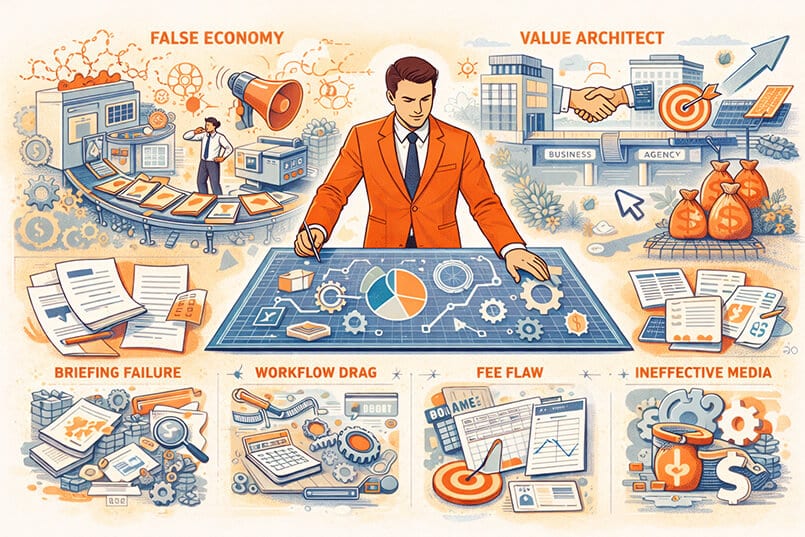
Before you can build value, you must ruthlessly eliminate waste. Our research identifies four categories where budget, time, and effort drain away—often due to poor procurement strategy:
1. Strategic and Creative Waste (The Briefing Failure)
The costliest waste happens before a single line of code or creative is produced. It is the waste of ambiguity. Procurement’s historical detachment from the early briefing stage has led to vague objectives, shifting scopes, and a lack of measurable outcomes. This forces the agency to guess, leading to the spiral of rework that consumes countless hours of internal marketing time.
The Fix: Procurement must embed rigour into the front end of the marketing process. The guide details how to mandate standardised, data-backed briefing protocols, ensuring the agency’s Purpose aligns with a quantifiable business outcome from Day One.
2. Operational and Production Waste (The Workflow Drag)
Modern marketing requires speed, but internal workflows are often clogged with manual handoffs, unclear approval structures, and duplicative efforts across markets. A major contributor here is the Unoptimized Internal Studio. Many organisations set up in-house teams for “speed and control,” but without procurement oversight, these studios often lack commercial rigour, suffer from poor utilisation, and deliver low productivity. They become a hidden cost centre disguised as a savings.
The Fix: You need to apply commercial performance metrics to your internal teams. Our guide shows you how to conduct a Production Consultancy audit, treating your in-house studio like a third-party vendor subject to KPIs for utilisation, speed-to-market, and efficiency, thereby eliminating operational drag across the entire supply chain (internal and external).
3. Commercial and Remuneration Waste (The Fee Flaw)
The classic commercial failure is the vague Scope of Work (SOW). If your SOW is merely a “laundry list of campaigns,” the agency is forced to “over-quote” to cover the inevitable risk and scope creep. Similarly, using outdated fee models (like the rigid FTE-based retainer) for project-based work leads to perpetual resource misalignment and overpayment.
The Fix: The solution lies in architecting new fee models that incentivise performance, not just presence. The guide provides the framework for shifting to performance-based contracts and using TrinityP3’s benchmarking data to define tight, quantifiable SOWs that pay the agency for value delivered, not hours consumed.
4. Media and Channel Waste (The Effectiveness Gap)
The digital landscape is rife with waste: ad fraud, low viewability, and channel redundancy driven by the desire to be “everywhere.” Furthermore, in a world focused on ESG (Environmental, Social, and Governance), the hidden Environmental Cost (Carbon Footprint) of excessive programmatic bidding is becoming a non-negotiable risk.
The Fix: Procurement must enforce media contracts with non-negotiable transparency clauses, third-party verification, and—critically—incorporate the carbon cost of communication as a measurable factor in media planning. This aligns procurement with corporate sustainability goals, mitigating both financial and reputational waste.
The AI Tsunami: Mitigating the New Catastrophic Risks
The arrival of Generative AI is amplifying marketing productivity but simultaneously introducing catastrophic new risks that can wipe out years of savings in a single lawsuit or brand crisis.
Procurement must urgently assume the mantle of Chief Risk Mitigator in the AI space. The guide provides the contractual blueprint necessary to manage this exposure:
- IP and Copyright Liability: If an AI-generated campaign asset is found to have infringed on a licensed work, the campaign is dead, and the legal costs are immense. Mitigation: The guide mandates Robust Contractual Indemnities from all vendors, guaranteeing the legal defensibility of AI outputs and enforcing the vetting of AI providers based on data provenance.
- Ethical and Bias Exposure: AI models can perpetuate bias, leading to discriminatory targeting or creative that is culturally insensitive. Mitigation: Procurement must demand documentation of AI Governance Models, ensuring that audits for bias and compliance are explicitly part of the contract.
The challenge of AI is not merely technical; it is commercial and legal. Procurement is the only function positioned to build the contractual firewalls necessary to protect the organisation from this new generation of waste.
The Blueprint for Transformation: Introducing the SMAP
Moving to this strategic mandate requires a formal, phased approach. Inside “The Value Architect,” you will find the complete Strategic Marketing Procurement Plan (SMAP)—a multi-year roadmap designed to operationalise change and govern value creation.
The SMAP is structured around the TrinityP3 P3 Framework: Purpose, People, and Process and involves three critical phases:
- Phase 1: Assess and Diagnose: Quantify the TCO (including the actual cost of your in-house agency). Establish the baseline for waste and risk exposure.
- Phase 2: Optimise and Structure: This is where you implement the Make vs. Buy decision, roll out performance-based contracts, and establish the Joint Operating Agreement (JOA) with marketing leadership.
- Phase 3: Govern and Measure (Ongoing): Enforce accountability through Quarterly Performance Scorecards and annual contract compliance reports, ensuring adherence to AI governance and waste-reduction KPIs (like Rework Reduction Rate).
By executing the SMAP, procurement stops being a tactical cost centre and becomes a Future-Proofing Partner. This engine ensures every dollar invested in marketing communications is an effective, high-performing dollar.
The stakes are too high to continue managing marketing spend based on outdated cost-cutting metrics. Download the complete guide, “The Value Architect: Marketing Procurement’s New Mandate,” today and gain the definitive strategic framework to eliminate waste, mitigate AI risk, and drive superior marketing performance for your organisation.
Click here to read and download the complete 5,000-word Strategic Guide.