TL;DR: The TrinityP3 Solution Design Framework
- The Flaw in ‘Best Practice’: Traditional consulting relies on rigid, one-size-fits-all recommendations that ignore an organisation’s culture, leading to risk aversion and severe change fatigue.
- The Power of the Current State: TrinityP3 anchors every project in a data-driven Current State audit. This establishes a documented baseline, aligns conflicting internal stakeholders, and prioritises which operational issues must be addressed or maintained.
- Three Paths, Not One: Rather than dictating a single answer, we design three valid solutions based on the organisation’s appetite for disruption:
- Trim the Hedges: Minimum disruption, maximum immediate optimisation.
- The Evolution: Balanced renovation to upgrade value while managing operational friction.
- The Greenfield Build: A revolutionary knockdown-and-rebuild unconstrained by current limitations.
- Co-Creation Equals Ownership: By presenting a spectrum of valid options, leadership teams are forced to confront their true appetite for change. They “try on” and co-design the final hybrid solution, creating the deep psychological ownership required for successful, long-term implementation.
There is a familiar and tired script in the world of management consulting. An organisation, facing a complex challenge or seeking to unlock new growth, engages an external consultancy. The consultants arrive, conduct their interviews, run their spreadsheets, and eventually present a weighty deck culminating in a single, definitive recommendation. This recommendation is almost invariably labelled as “industry best practice.”
It is presented as the singular, unassailable truth, the definitive path forward. You are told that if you simply implement this blueprint, your problems will be solved.
At TrinityP3, we fundamentally disagree with this approach. When we design solutions for our clients, we adopt a markedly different methodology compared to many of our consulting competitors. It is one of the core elements that defines how we are different. We do not believe in the myth of a universal “best practice” because what is best for one organisation, with its unique culture, constraints, and resources, can be disastrous for another.
Instead of dictating a singular answer, we believe in a highly contextualised, co-creative process. Here is why our approach to designing solutions goes beyond the standard consulting playbook, and why it consistently delivers superior, sustainable results for the marketing teams we partner with.
Anchoring the Solution in the ‘Current State’
Any robust solution must be built on a foundation of reality. When designing solutions, we take a rigorously data-driven approach. However, we define “data” far more broadly than mere numbers on a spreadsheet.
Our analysis encompasses highly structured data: financial metrics, marketing spend, media performance, agency remuneration, output volumes, process maps, and seasonality. But equally critical is the unstructured data we gather: the organisational culture, the internal politics, the established ways of working, and the unwritten rules that dictate how things actually get done.
We utilise both the structured and unstructured data to define the ‘Current State’. This is a critical step, as it anchors any proposed solution in a shared, agreed-upon reality.
Think of the fundamental strategy process, which is essentially a journey through five questions:
- Where are we now?
- Why are we here?
- Where do we want to be?
- How do we get there?
- How do we know when we have achieved this?
This entire strategic journey is entirely dependent on the first question: Where are we now? Without it, it is dangerously easy to solve the wrong issue.
The Fallacy of “We Already Know Where We Are”
Despite the obvious logic of mapping the starting line, we frequently encounter resistance at this initial stage. Many stakeholders believe that defining the current state is a waste of time and effort. The prevailing sentiment is often, “We live this every day; we already know exactly what our current state is. Let’s skip the history lesson and jump straight to the solutions.”
This is a dangerous assumption that frequently derails transformation initiatives before they even begin. Skipping this diagnostic phase overlooks three critical strategic truths:
- The Current State is Rarely Universally Agreed: While individual leaders feel they understand their reality, that view is highly subjective. What the CMO views as the current state is often vastly different from the perspective of the Procurement Director, the finance team, or the external agency partners. Without an objective, independent baseline, you are attempting to build a future strategy on fractured, conflicting assumptions.
- Undocumented Baselines Dissolve Mid-Transformation: Even if a leadership team holds a loose, unspoken consensus about their current situation, it is rarely formally recorded. As any change implementation progresses, the ground inevitably shifts and internal memories blur. Without a rigorously documented “before” snapshot, you lose sight of where you started. This makes it virtually impossible to accurately measure progress or objectively prove the value and ROI of the ultimate solution.
- It Forces Crucial Prioritisation: Documenting the current state is not merely an administrative exercise; it is an active diagnostic tool. It provides a structured opportunity for the team to look at their operations holistically and categorise their findings. It allows them to explicitly prioritise which current state issues must be aggressively addressed, and conversely, which high-performing elements are working well and must be protected and maintained. This clarity is absolutely essential before a single pen is lifted to design a future solution.
The Three Paths of Solution Design
Once the current situation is mapped, agreed upon, and the priorities are clearly identified, we move to solution design. This is where our divergence from traditional consulting becomes most apparent. Rather than presenting a single “best practice” recommendation, we design and present a range of solutions across three distinct paths.
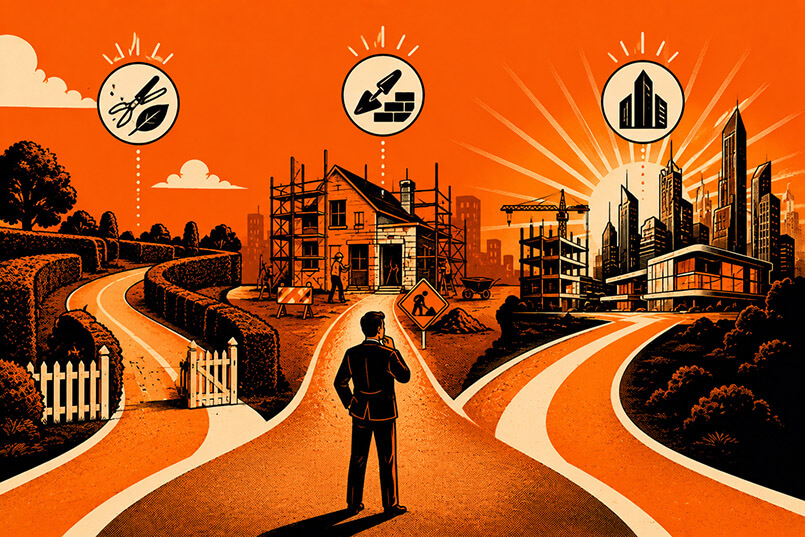
To explain this, we often use the metaphor of property development.
|
THE THREE DESIGN PATHS |
||
|
1. TRIM THE HEDGES (Minimum Disruption) Optimise what exists for immediate value. |
2. THE EVOLUTION (The Balanced Move) Renovate and upgrade for maximum potential. |
3. GREENFIELD BUILD (Maximum Benefit) Knockdown & rebuild completely fresh. |
- Trim the Hedges (Minimum Disruption, Maximum Immediate Benefit)
This path asks: what is the minimum level of disruption we can introduce to deliver the maximum immediate benefit? In the property metaphor, this is akin to giving a house a thorough tidy up, a fresh coat of paint, and a garden trim before putting it on the market. You are not changing the fundamental structure, but you are optimising what is already there to add significant value. In a marketing context, this might involve tweaking an existing agency roster, streamlining a specific approval process, or renegotiating existing contracts.
- The Greenfield Build (Maximum Benefit, Unconstrained by Disruption)
This is the other extreme. We ask: if we were designing this marketing ecosystem from a completely greenfield perspective, without any regard for the disruption it would cause, how would we build it to maximise the ultimate benefit? To continue the metaphor, this is the knockdown and rebuild. It is sweeping, revolutionary change. It might involve moving entirely to an in-house agency model, completely restructuring the marketing department, or rebuilding the entire technology stack from scratch.
- The Evolution (The Middle Ground)
This is the pragmatic middle option, representing an evolution between the first two extremes. How do we renovate the existing structure to achieve the maximum potential benefit while simultaneously minimising the disruption to ongoing operations? You are keeping the foundations but perhaps upgrading the kitchen and adding an extension. In marketing, this might mean keeping the core strategic agency partners but completely overhauling the digital and production supply chains.
The Crucial Missing Metric: The Appetite for Change
Why do we take the time to build and present these three distinct paths? Because while consultants can provide an objective, third-party view of an organisation’s issues, and can draw upon extensive experience across a wide selection of categories to design solutions, there is one crucial variable that we cannot dictate.
That variable is the organisation’s appetites for change and disruption.
We have walked into countless organisations that are literally exhausted from relentless change—whether that change has been driven by external consultants or internal restructures. Change fatigue is a very real, very powerful barrier to success.
By providing a range of solutions with varying levels of change and disruption, we provide the necessary stimulus for a vital conversation. It forces the leadership team to confront and agree upon their actual appetite for transformation.
We firmly believe that any issue, problem, or opportunity will always have many possible, valid solutions. We only ever present options that are structurally sound and commercially viable, and we always provide clear context regarding the foreseeable level of disruption and the potential benefits of each.
However, none of these options is inherently our “best” option. They are all valid. It is only through rigorous, honest discussion with the leadership team that we are able to resolve which path is truly the best fit for that particular organisation at that particular point in time.
Overcoming Resistance to Co-Creation
We do acknowledge that there is occasionally resistance to this co-creative approach. We sometimes encounter stakeholders who are specifically looking for a single recommendation to blindly follow.
Often, this desire for a singular answer is rooted in a culture of risk aversion. If the consultants deliver a single “best practice” recommendation and it fails, the leadership can comfortably place the blame squarely on the shoulders of the external advisors. It provides an illusion of safety.
But we do not operate to provide our clients with plausible deniability; we operate to deliver successful marketing transformations. Our multi-option approach serves three vital purposes:
- Testing the Appetite for Disruption It forces the business to quantify how much operational pain they are genuinely willing to endure for the promised strategic gain. It aligns the executive team on the realities of the road ahead before the journey begins.
- “Trying On” the Solutions In exploring the three options with the leadership team, we start to collectively “try on” the various paths. We explore which parts feel natural to the organisational culture and which feel uncomfortable. We identify elements that need improving. Very often, this collaborative workshop process results in the emergence of a fourth option—a superior, hybrid solution. Furthermore, this process provides an early, clear understanding of the potential resistance and internal sticking points that will inevitably need to be addressed during implementation.
- Fostering True Ownership This is arguably the most important purpose of all. This customisation process is an opportunity for the organisation’s leadership to commence taking ownership of the emerging solution. When leaders have debated, pulled apart, and ultimately co-designed the path forward, they are infinitely more invested in its success than if they were simply handed a mandate from a consultant. This psychological ownership dramatically increases the chance of successful implementation.
The Choice is Yours
We know our approach is not for everyone. If you are seeking a pre-packaged, off-the-shelf “best practice” deck to simply rubber-stamp, there are plenty of consultancies willing to provide one.
However, we have consistently noticed that those organisations that understand the underlying strategy of our approach find that their implementation phase is significantly more successful. Why? Because the solution they are implementing has been custom-fitted and aligned to their specific organisational culture, rather than fighting against it.
Change is never easy. But in the face of the relentless, accelerating change going on all around us in the media and marketing landscape, marketing operations and structures must inevitably adapt.
The question is: does your marketing function require an evolution, a revolution, or simply a thorough tidying up of what you are already doing?
As consultants, we can illuminate the paths, calculate the costs, accurately record your baseline, and predict the benefits. But ultimately, that is a decision we believe is yours to make.
To discover more about what makes the TrinityP3 approach innovative and effective you can read what makes us different here. Or contact us to discuss how that difference will help you transforming your marketing more effectivnely.
Frequently Asked Questions
Why is “best practice” consulting often ineffective for marketing teams?
Standard “best practice” consulting often fails because it relies on a rigid, one-size-fits-all blueprint that completely ignores an organisation’s unique culture, internal politics, and operational constraints. It assumes every business has the same capacity for disruption, which frequently triggers internal resistance and severe change fatigue.
Why is defining the current state essential before designing a new marketing solution?
Defining the current state establishes an objective, universally agreed baseline across conflicting internal departments, ensuring you are solving the actual problems rather than theoretical ones. It documents a rigorous “before” snapshot that is essential for measuring future ROI, whilst forcing teams to prioritise which issues to aggressively address or maintain.
What are the three paths of marketing solution design?
TrinityP3 designs solutions across three strategic paths: Trim the Hedges (optimising existing operations with minimal disruption), The Evolution (renovating structures for high value with balanced disruption), and The Greenfield Build (a revolutionary knockdown-and-rebuild unconstrained by current limitations). This gives leadership teams options that match their exact operational reality.
Why does TrinityP3 present multiple solutions instead of a single recommendation?
Presenting multiple valid options forces an organisation’s leadership to confront and align on their true appetite for change and disruption. This co-creative process allows teams to “try on” different models, uncover potential implementation sticking points, and co-design a hybrid solution, fostering the deep psychological ownership required for long-term success.
How does change fatigue impact marketing transformation?
Change fatigue occurs when an organisation is exhausted by relentless, poorly integrated restructures, causing teams to reject new initiatives. By presenting a spectrum of solutions with varying levels of disruption—rather than a single mandated recommendation—leadership can actively select a transformation pace that their culture can realistically absorb and sustain.