
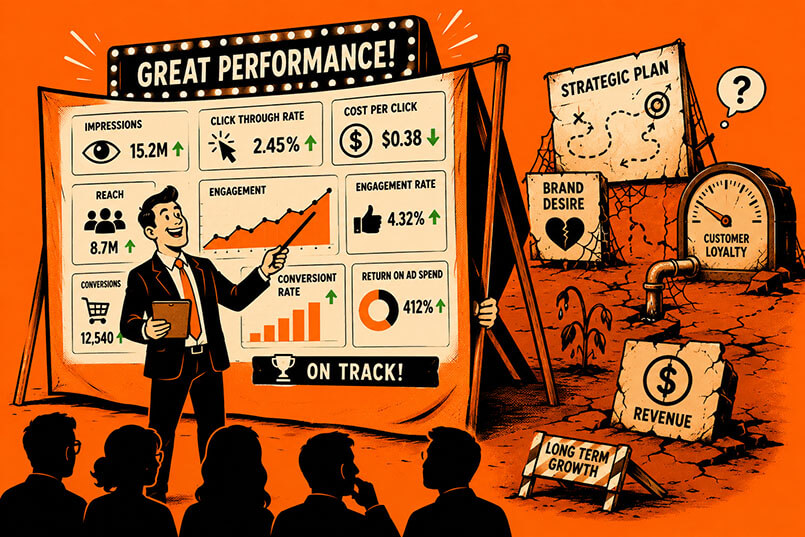
Every year, marketing teams spend weeks, if not months, crafting a “Strategic Plan”. It’s a beautifully formatted document filled with ambitions of market expansion, brand rejuvenation, and customer centricity. But once the plan is approved and the campaigns are live, a strange thing happens: the measurement of that strategy often devolves into a weekly PDF from an agency showing a slightly green arrow next to a “Cost Per Click” metric.
There is a fundamental disconnect in modern marketing between what we planned to do and how we measure if we’re actually doing it.
In my role as a marketing measurement consultant, I frequently see CMOs who are data-rich but insight-poor. They have dashboards that can tell them how many people in a specific postcode clicked an ad on a Tuesday afternoon, but they can’t tell their Board if the $10 million brand relaunch has actually increased “desire” or shifted the needle on long-term commercial value.
If your measurement framework isn’t explicitly designed to answer whether you are delivering your strategic plan, it’s not a framework—it’s just a collection of numbers. Here is how to build a measurement ecosystem that actually serves the strategy.
1. Commercial Rigour: Moving Beyond the “Vanity” Funnel
The first hurdle is moving beyond vanity metrics. We’ve all seen the reports filled with “Impressions,” “Reach,” and “Engagement.” While these aren’t useless, they are often used as a defensive shield rather than a commercial tool.
Commercial rigour in measurement means ensuring that every stage of the marketing funnel is measured against its specific strategic intent.
The Full-Funnel Reality Check
A high-performance measurement framework must track the transition of a consumer from a state of ignorance to a state of high-lifetime value. This requires different “yardsticks” for different goals:
- Brand Health & Saliency: Are you “top of mind” when the consumer enters the category? This isn’t measured in clicks; it’s measured in mental availability and saliency.
- Consideration & Desire: Is your strategy successfully moving people from “I know them” to “I want them”? Measuring “Desire” or “Interest” requires sophisticated sentiment analysis and brand tracking that correlates with future sales intent.
- Driving Demand: This is where the “bottom of the funnel” lives, but even here, rigour is required. It’s not just about the transaction; it’s about the value of that transaction.
If your strategic plan says “we will become the premium choice in the category,” but your measurement framework only rewards the lowest “Cost Per Acquisition,” you are effectively incentivising your team to undermine your strategy by chasing low-value, discount-driven customers.
2. The “So What?” Factor: Overcoming Shallow Media Reports
Most media reports are autogenerated post-rationalisations. They tell you what was bought and how many people saw it, but they rarely deliver real insight into whether the strategy worked.
An agency report might tell you that your video completion rate was 75%. That sounds great. But the strategic question is: “Did those 75% of people walk away with the specific brand message we intended to land?” ### From Reporting to Insight To overcome shallow reporting, marketers need to demand a “So What?” layer in their measurement.
- The Intent Test: Did the media placement align with the strategic intent? If the goal was brand-building, why are we being reported on for short-term conversion?
- Strategic Attribution: Instead of looking at channel performance in isolation, we should be looking at how channels worked together to deliver a strategic pillar.
If your media reports don’t include a narrative that links back to your strategic pillars, they are just noise. A measurement consultant helps bridge this gap by redesigning the reporting structure so that it speaks the language of the business plan, not the language of the ad-server.
3. The Incrementality Imperative: Measuring Impact, Not Just Presence
One of the most dangerous traps in marketing is taking credit for sales that would have happened anyway. This is the difference between “Existing State of Play” and “Incremental Impact.”
If you turn off your search ads for your own brand name tomorrow, how many of those people would have clicked the organic link right below it anyway? If the answer is “most of them,” then your “Marketing ROI” on that spend is a fiction.
Proving the “Lift”
A robust measurement framework must be obsessed with incrementality. It needs to answer: “What did marketing add that wouldn’t have occurred otherwise?”
- Baseline vs. Incremental: You must establish what your “organic” or “baseline” sales look like without marketing activity.
- Experimental Design: This involves using “Hold-out tests” or “Geo-tests” where you intentionally stop or change marketing in one region to see the real-world impact compared to a control group.
Measuring incremental impact is the only way to gain true credibility with the CFO. It moves marketing from being seen as a “tax on sales” to a “generator of growth.”
4. Aligning the Measurement “Trinity”
Marketers often struggle because they are trying to use a hammer to turn a screw. They use Digital Attribution to try and measure Brand Equity, or they use Brand Tracking to try and optimise a weekend sale.
A sophisticated measurement framework aligns three distinct but complementary approaches:
A. Marketing Mix Modelling (MMM) / Econometrics
This is the “Macro” view. It looks at long-term trends, external factors (the economy, competitors, pricing), and the holistic impact of all marketing channels over years. It’s best for answering: “How should I allocate my budget next year?”
B. Digital Attribution / MTA
This is the “Micro” view. It tracks the digital path to purchase. It’s best for answering: “Which specific creative or keyword is performing best this week?”
C. Experiments and Lift Studies
This is the “Truth” view. It uses scientific testing to validate the other two models. It’s best for answering: “Does this channel actually drive incremental sales?”
The role of a measurement consultant is to ensure these three approaches aren’t fighting each other. When they are aligned, you get a “triangulated” view of the truth that allows you to pivot your strategy with confidence.
How TrinityP3 Supports Measurement Excellence
The path to a commercially rigorous measurement framework is often blocked by “the way we’ve always done it.” Agencies are often hesitant to move toward incrementality testing because it might reveal that some of their activities aren’t as effective as the “last-click” suggests.
At TrinityP3, we provide the independent oversight required to build a Marketing Effectiveness and Measurement framework that is purely focused on your commercial success.
We help organisations:
- Audit current reporting: Identifying where vanity metrics are hiding a lack of strategic progress.
- Design bespoke frameworks: Aligning your KPIs directly to your 1-year and 3-year strategic plans.
- Implement Incrementality testing: Moving your measurement from “correlation” to “causality.”
- Integrate data sources: Ensuring MMM, Attribution, and Brand Health tracking provide a single, unified story.
Your Next Step: The Marketing Effectiveness Assessment
Is your current measurement framework helping you win, or is it just helping you justify your job? Most marketers are operating with at least one “blind spot” in their data—and usually, it’s the spot where the most important strategic decisions need to be made.
To help you identify where your measurement is failing your strategy, we invite you to take the Marketing Effectiveness and Measurement Assessment.
This diagnostic tool will help you determine:
- If your metrics are focused on commercial impact or tactical vanity.
- Whether you are accurately measuring the “long” (brand) and the “short” (performance).
- If your reporting is providing real strategic insight or just data dumps.
- How prepared you are to prove incremental value to your Board.
Take the TrinityP3 Marketing Effectiveness Assessment here.
Measurement should be the wind in your sails, not the anchor dragging behind your ship. By bringing commercial rigour, incrementality, and strategic alignment to your data, you stop “reporting on the past” and start “engineering the future.” The time to fix your framework is before the next quarterly review, not during it.