Legal Disclaimer: This article provides general information and commentary on legal matters for educational purposes only. TrinityP3 is not a legal practitioner and does not provide legal advice. The content contained herein should not be relied upon as a substitute for professional legal consultation. We strongly recommend that readers seek independent legal advice tailored to their specific circumstances before taking any action based on the information provided in this article.
In the marketing landscape, the transition from “voluntary ethical guidelines” to “mandatory legal frameworks” appears complete. As a marketing management expert at TrinityP3, we’ve seen the industry move from debating what is right to frantically assisting marketers and their agencies to manage the risks.
With the EU AI Act enforceable from August 2026 and a wave of state-level laws in the US (California’s SB 942 and Colorado’s AI Act) now in full effect, the “wait and see” approach to AI governance is officially a legal liability.
Key Takeaways: AI Compliance
- Transparency Mandates: Mandatory watermarking and disclosure of synthetic content are now legal requirements in major jurisdictions.
- Liability for Hallucinations: Brands are legally responsible for AI-generated misinformation, regardless of the vendor’s disclaimer.
- Data Provenance: New “Right to Know” laws require brands to disclose the training data sources used by their generative AI tools.
- Algorithmic Discrimination: Regulators (FTC, ACCC) are treating biased AI targeting as a violation of civil rights and consumer protection laws.
- Contractual Sovereignty: Master Service Agreements (MSAs) must now include specific clauses for AI IP indemnification and “Zero Data Retention.”
The Top 10 Legal & Regulatory Compliance Issues for Marketers
1. Disclosure of Synthetic Content (The Transparency Mandate)
By mid-2026, disclosure is no longer a “best practice”—it’s the law. The EU AI Act and California’s SB 942 require that any AI-generated image, video, or audio that could be mistaken for a real person or event carry technical markers (metadata) and visible disclosures.
Compliance Risk: Failing to label a “deepfake” or synthetic influencer can lead to fines of up to 7% of global turnover under the most stringent regimes. Marketers must ensure their suppliers are embedding “latent disclosures” that persist even if the file is edited.
2. Liability for AI “Hallucinations” & Misinformation
If your AI chatbot promises a discount or misquotes a product’s safety specifications, you are legally bound by that claim. In 2026, courts are increasingly rejecting the “technical error” defence.
Compliance Risk: Marketers are being held to the same standard as a human salesperson. Regulatory bodies like the FTC (under the March 11, 2026 Policy Statement) treat AI hallucinations as “unfair or deceptive acts.” This necessitates a robust Agentic Auditor framework—using one AI to police the output of another before it reaches the consumer.
3. Intellectual Property (IP) & Training Data Provenance
The “AI Training Data Transparency Act” (California AB 2013) now mandates that developers publish summaries of their training datasets. For marketers, using a tool trained on unlicensed copyrighted material is a ticking litigation bomb.
Compliance Risk: Using AI-generated assets without verified IP Indemnification from your supplier leaves your brand vulnerable to secondary infringement claims. Marketers must demand “Clean Data” certification from every AI vendor in their supply chain.
4. Algorithmic Discrimination & Bias Auditing
Automated audience targeting is under the microscope. Regulators now use “disparate impact” tests to see if AI models are inadvertently excluding protected classes from housing, credit, or employment ads.
Compliance Risk: Under Colorado’s AI Act (effective June 2026), deployers of “high-risk” AI must conduct annual impact assessments. If your programmatic AI shifts spend away from certain zip codes based on demographic proxies, you face significant civil penalties for discriminatory practice.
5. Data Sovereignty & “Model Ingestion”
Privacy laws like the GDPR and CCPA have evolved. The issue isn’t just how you collect data, but whether you’ve allowed that data to be “ingested” to train a third-party LLM.
Compliance Risk: If a customer invokes their “Right to be Forgotten,” and their data has already been used to train a global model, you face a technical and legal impossibility. Compliance requires using Private AI Instances where data is never used to train the base model.
6. Rights of Publicity & Digital Likeness
The unauthorized use of digital clones (voice or image) of celebrities—or even customers—is now heavily regulated.
Compliance Risk: Marketers must obtain explicit “Digital Likeness” waivers. Relying on “AI-generated persons who look like” a celebrity is increasingly seen as a violation of the NO FAKES Act or similar state-level right-of-publicity laws.
7. AI-Washing & Substantiation of Claims
The FTC and ACCC are aggressively targeting “AI-Washing”—the act of claiming a product is “AI-powered” when it merely uses basic automation or manual processes.
Compliance Risk: Following the 2026 Growth Cave and Workado resolutions, marketers must be able to substantiate exactly how AI improves their product’s effectiveness. Exaggerated efficiency claims are now a primary target for consumer protection enforcement.
8. Section 5 Compliance & “Dark Patterns” in AI
AI is being used to create “highly adaptive” interfaces that nudge consumers toward purchases using psychological vulnerabilities.
Compliance Risk: Regulators now classify AI-driven “predatory nudging” as a deceptive dark pattern. Any AI system that adapts in real-time to exploit a consumer’s emotional state (detected via biometric data) is likely in violation of Section 5 of the FTC Act or the Digital Services Act (DSA).
9. Supplier Accountability & The Chain of Responsibility
Many marketers are “inheriting” compliance failures from their agencies or MarTech suppliers.
Compliance Risk: You cannot outsource your liability. In 2026, TrinityP3 recommends that all MSAs include an AI Compliance Addendum. This should define the supplier’s responsibility for bias testing, hallucination mitigation, and the use of licensed training data.
10. Auditability & “Explainable AI” (XAI)
If a regulator asks why a customer was denied a service or served a specific price by your AI, “the algorithm decided” is no longer a legal answer.
Compliance Risk: Marketers must maintain an AI Decision Log. Regulatory frameworks now demand a level of “Explainability”—the ability to provide a plain-language explanation of the factors that influenced an automated decision.
AI Compliance Checklist
This provides a baseline for auditing your marketing operations.
- [ ] Watermarking: Does our synthetic content include latent metadata for detection?
- [ ] IP Indemnification: Have all AI suppliers signed an IP indemnity for their output?
- [ ] DPA Updates: Do our Data Processing Agreements specifically prohibit “model training” on our client/customer data?
- [ ] Bias Testing: Have we performed a “Disparate Impact” audit on our programmatic targeting this quarter?
- [ ] Hallucination Protocol: Is there a human-in-the-loop sign-off for all AI-generated consumer-facing claims?
- [ ] Regulatory Mapping: Does our AI use-case list identify “high-risk” systems under the EU AI Act or Colorado AI Act?
FAQ: AI Legal & Regulatory Landscape
Who is liable if an AI-generated ad is misleading?
The brand (the advertiser) is ultimately liable. While you may have a right of recourse against your agency, consumer protection agencies (like the FTC or ACCC) hold the brand responsible for all commercial communications, regardless of the technology used to create them.
What is the penalty for not disclosing AI-generated content?
Under the EU AI Act, fines for non-compliance with transparency obligations can reach up to €15 million or 3% of total global annual turnover, whichever is higher. In the US, penalties vary by state but typically involve civil penalties per violation.
Can we use customer data to train our own AI models?
Only if you have explicit, informed consent that specifically mentions AI training. Standard “use for marketing purposes” clauses are increasingly seen as insufficient for the permanent ingestion of data into a machine learning model.
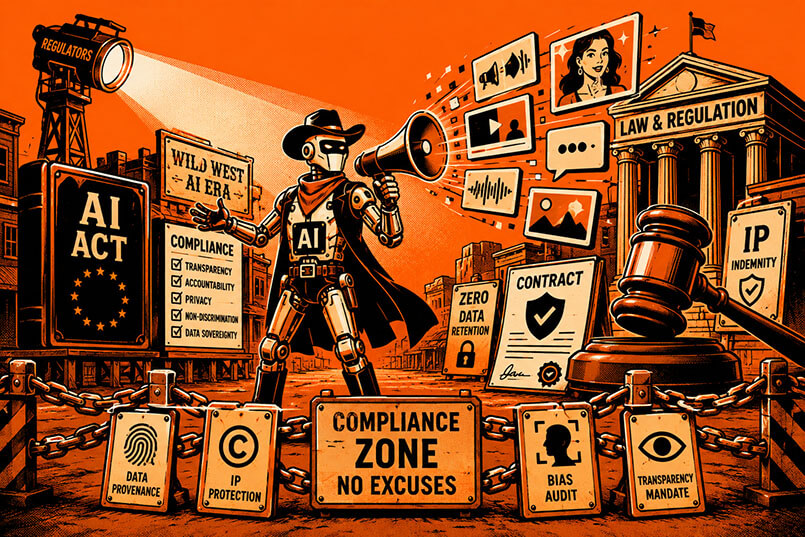
AI is no longer a “Wild West.” It is a highly regulated territory. The brands that will succeed are those that treat compliance not as a “legal hurdle,” but as a strategic foundation for long-term consumer trust.