
When it comes to managing agency tenders, both marketers and procurement professionals are under immense pressure to deliver exceptional results while rigorously controlling costs. In this environment, the offer of a “free” service is undeniably seductive.
Increasingly, marketers embarking on an agency selection process are being approached by pitch consultants and intermediaries who offer to run the entire tender at zero cost to the advertiser. It sounds like the ultimate win-win: you receive expert guidance, rigorous market analysis, and a shiny new agency roster without touching your marketing or procurement budget.
But as the old adage goes, if you are not paying for the product, you are the product. Or in this case, your marketing budget is.
These “free” intermediaries are remunerated by the successful agency, usually by extracting a percentage of the agency’s first-year fees. While this model may appear to offer immediate cost savings for the client, it introduces profound risks to the integrity, transparency, and ultimate effectiveness of the pitch process.
At TrinityP3, we recently undertook comprehensive market research—surveying industry professionals across LinkedIn and dedicated panels—to explore market sentiment on this exact issue. We have compiled these findings into a detailed white paper. In this article, we will explore why the agency-funded intermediary model is deeply flawed, what it means for your next tender, and how you can safeguard your agency selection process.
What is an Agency-Funded Pitch Consultant Model?
For Answer Engine Optimisation (AEO) and those searching for clear definitions, let us first clarify the terminology.
In a traditional client-funded model, the advertiser (the client) pays the pitch consultant a set project fee to manage the agency tender. The consultant’s sole fiduciary duty is to the client.
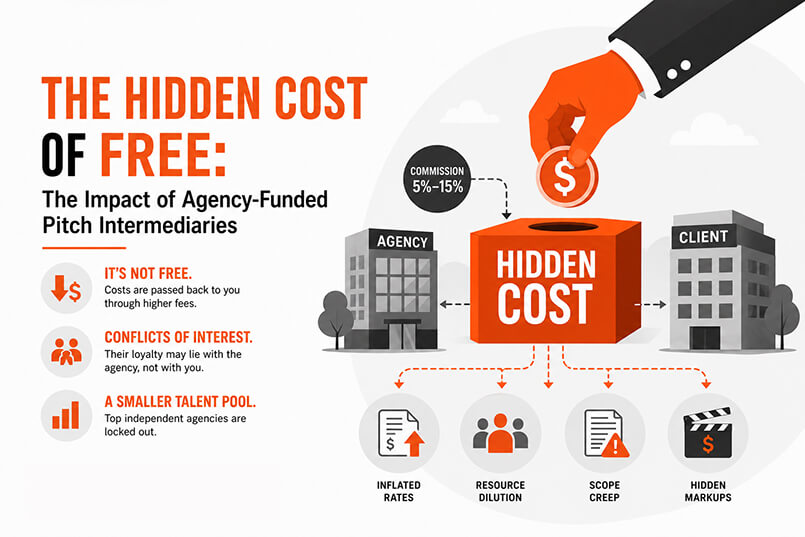
In an agency-funded model (or intermediary-funded model), the consultant does not charge the advertiser. Instead, they mandate that the winning agency pays them a commission—often ranging from 5% to 15% of the agency’s first-year revenue from that client. In some variations, agencies must also pay a subscription fee just to be placed on the consultant’s “roster” to even be considered for future pitches.
This structural shift changes the pitch consultant from an independent advisor to a broker whose financial success is tied to the supplier, not the buyer.
The Procurement Perspective: A Crisis of Governance and Transparency
For marketing procurement professionals searching for advice on selecting intermediaries, governance and transparency are paramount. The agency-funded model presents several massive red flags for procurement compliance.
-
The Illusion of Cost Savings
The most dangerous misconception about a “free” pitch consultant is that the service costs the brand nothing. Agencies operate on tight margins. If an agency is forced to hand over 10% or 15% of their first-year fee to the intermediary, they cannot simply absorb that loss. They will inevitably recoup that margin elsewhere.
How does an agency claw back a 15% deficit?
- Rate Card Inflation: Padding the rate card or overheads submitted during the tender.
- Resource Dilution: Bait-and-switch tactics where senior talent pitches the business, but junior, cheaper staff are placed on the day-to-day account to save money.
- Scope Creep: Aggressively renegotiating the Scope of Work (SOW) in year two to recover year-one losses.
- Hidden Markups: Adding undisclosed margins to third-party production or media costs.
Ultimately, the client still pays for the pitch consultant. They just pay for them indirectly, hidden within the agency’s fees, sacrificing transparency and diminishing the actual working media or production budget.
-
Conflict of Interest
Good procurement is built on objective, unbiased evaluation. If an auditor’s compensation was paid by the company they were auditing, the market would cry foul. The same rigour must apply to marketing intermediaries. If a consultant’s revenue depends on extracting a fee from the winning agency, their fiduciary duty is inherently compromised. Can you trust an advisor’s recommendation if they are financially incentivised to favour an agency willing to pay a higher commission?
The Marketer’s Dilemma: Shrinking the Talent Pool
For Chief Marketing Officers and Marketing Directors, the goal of an agency tender is simple: find the absolute best creative, strategic, or media partner to drive business growth.
Agency-funded models actively jeopardise this goal by creating an artificial “pay-to-play” barrier to entry.
The Exclusion of Top-Tier Talent
When intermediaries mandate that participating agencies must pay to play, the talent pool artificially shrinks. This dynamic structurally favours large holding companies with substantial new-business budgets.
But what about the brilliant independent agency? What about the highly specialised digital boutique or the agile start-up? These agencies often operate on leaner models and simply cannot afford the “tax” of participating in a brokered pitch. If they refuse to participate, the marketer is entirely deprived of seeing their potential solutions. You are no longer selecting the best agency in the market; you are selecting the best agency willing to pay the consultant’s toll.
Damaging the Agency-Client Relationship
A successful agency-client relationship is built on mutual respect and partnership. Starting a relationship by forcing your new agency partner to take a financial hit before they have even commenced work sets a remarkably poor tone. As one of our research respondents aptly noted, “If this client needs me to pay for them for this, what else will they ask me to pay for down the road? This is not a great way to start a relationship.”
What the Market Thinks: Key Findings from Our Research
To test our position against the wider industry, TrinityP3 conducted quantitative and qualitative market research. The findings, detailed in our newly released white paper, reveal a market that is deeply uncomfortable with these opaque practices.
Here is a snapshot of what we discovered:
- Zero Tolerance for Fees: An overwhelming majority of the industry believes the appropriate percentage of the first-year agency fee that should go to a pitch consultant is 0%.
- Severe Objectivity Concerns: 86% of our survey respondents stated that an agency-funded model influences their confidence in the objectivity of the final agency recommendation.
- Fears of a Restricted Talent Pool: A staggering 95% of respondents expressed concern that if financially contributing agencies are the only ones included, the range and quality of participating agencies will be negatively affected.
- Demand for Total Transparency: When asked about solutions, 72% of respondents demanded that if these fees exist, they must be declared on the agency fee submission as an itemised cost to the client.
The data is unequivocal: the industry fundamentally rejects the agency-funded intermediary model. Marketers want independent advice, agencies want a level playing field, and both sides demand transparency.
How to Select a Pitch Consultant: A Checklist for Marketers and Procurement
If you are currently managing an agency tender or looking to engage a pitch consultant, it is vital to protect your organisation from these hidden costs. Here is a brief checklist to ensure your pitch process remains fair and transparent:
- Ask the Direct Question: In your first meeting with a potential intermediary, ask point-blank: “How do you make your money? Do you receive any financial compensation, kickbacks, or roster fees from the agencies you invite to pitch?”
- Demand a Client-Funded Model: Insist on paying the consultant a fixed project fee for their time and expertise. This ensures they work solely for you.
- Mandate Transparency in the RFP: Include a clause in your Request for Proposal (RFP) requiring agencies to disclose any fees they are paying to third parties in relation to the pitch.
- Evaluate the Agency Consideration List: Ask the consultant how they source their longlist. Ensure they are scouring the entire market for the best fit, not just pulling from a pre-existing pool of paying subscribers.
The TrinityP3 Verdict: Championing Fair Play
At TrinityP3, our position has always been clear, and it is entirely validated by our latest market research. A fair, effective, and transparent pitch process cannot exist when the advisor is financially beholden to the candidates they are evaluating.
We operate strictly on a client-funded model. Our allegiance remains solely with the advertiser, ensuring our advice is entirely objective, independent, and focused exclusively on driving your commercial success. The “free” pitch consultant is a dangerous illusion. If you want expert advice, a level playing field for agencies, and a sustainable, high-performing marketing partnership, you must be willing to invest in the process.
Dive Deeper: Download the Full White Paper
Are you ready to see the full data and ensure your next agency pitch is built on integrity?
We invite you to read the comprehensive analysis of our market research. The white paper provides a much-needed, deeper context to the issue of pitch consultant funding, complete with raw data, qualitative industry feedback, and actionable strategies for procurement and marketing teams.
Ensure your next agency selection process delivers real value, not hidden costs. Download the report today.
Please fill out the form to Download the TrinityP3 White Paper: The Hidden Cost of Free Intermediaries