
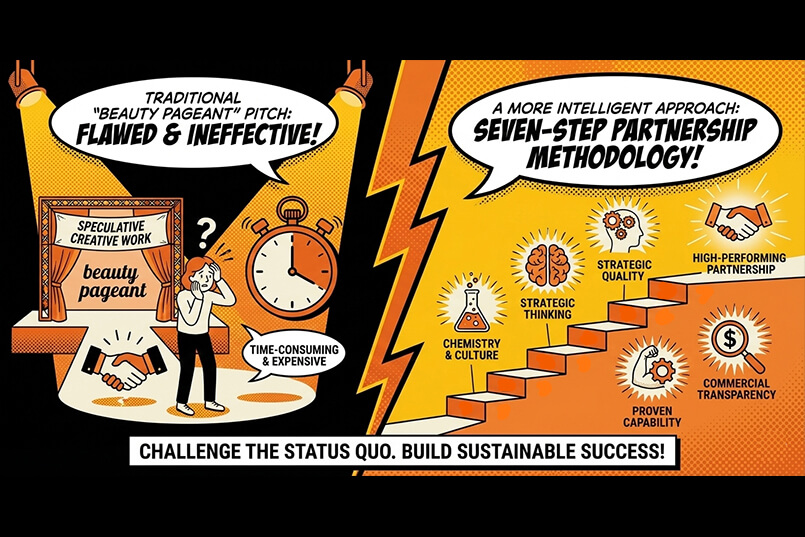
For decades, the default approach to selecting a marketing agency has been a time-consuming, expensive, and often ineffective beauty pageant built around speculative creative work. Marketers ask multiple agencies to produce creative concepts for free, hoping to find a winning idea.
The reality? This process rarely leads to a truly successful long-term partnership. It tests a quick, often superficial creative output under artificial pressure, not the agency’s real-world problem-solving skills, cultural fit, or commercial acumen. The traditional pitch is flawed because it prioritises a single, high-stakes creative moment over a proven, sustainable working methodology.
It’s time for a more intelligent, pragmatic, and commercially sound approach. The best selection processes focus on testing the core ingredients of a successful partnership: chemistry, strategic thinking, proven capability, and commercial transparency.
This article outlines a seven-step methodology that challenges the status quo and is designed to deliver a high-performing, sustainable agency partnership.
The TrinityP3 7-Step Agency Selection Methodology
Choosing the right agency is a critical business decision that requires structure, discipline, and a focus on long-term value. Here are the seven steps to a smarter agency selection process.
Step 1: Define Your Situation and Success
Before considering which agencies to contact, you must have a very clear understanding of your needs. This begins with a detailed review and definition of your current situation and needs to clearly state what a successful outcome would be.
- What business problem are you addressing? Is it a sales downturn, a brand perception issue, a market penetration challenge, or a capability gap within your current team?
- Articulate the desired outcome: Success must be defined with measurable criteria. Is it a $20 million boost in revenue, a 15% increase in brand equity, or the successful launch of a new product line? This quantifiable outcome becomes the firm non-negotiable north star for the entire agency selection process.
- Audit current performance: Understand what’s working and what isn’t with your current agencies or internal setup. This diagnostic work is the foundation for a targeted and effective agency search.
Key Takeaway: The first and most critical step is to define the measurable successful outcome to guide the entire agency selection process.
Step 2: Align All Internal Stakeholders
An agency selection process is an organisational change project. The chosen agency will work across your business, requiring input, resources, and sign-off from multiple departments. Failure to align these internal partners is the single biggest cause of pitch derailment.
- Bring everyone to the table: You must align all internal stakeholders, including management, finance, procurement, legal, and the other agencies in your current roster of marketing suppliers.
- Define roles and criteria: Procurement needs to be aligned on the commercial structure, Legal on contractual terms (especially IP), and Finance on budget and payment terms.
- Integrate your existing roster: Clearly define the new agency’s role and responsibilities relative to your existing marketing suppliers. This avoids costly duplication, internal friction, and execution gaps.
Key Takeaway: Aligning internal stakeholders, including procurement and legal, ensures process efficiency and prevents long-term commercial or contractual friction.
Step 3: Define a Process to Test Core Competencies
Your process should test the qualities that truly matter for a successful, long-term working relationship, not just a one-off piece of creative. This step requires you to define a process that tests the most important aspects of success, such as chemistry, strategic thinking, or problem-solving skills.
- Chemistry Meetings: These brief, structured meetings assess cultural fit and personality. You are testing if you enjoy being in a room with them under pressure.
- Review Case Studies: Focus on compelling case studies that demonstrate the agency’s ability to solve problems analogous to yours and deliver similar measurable outcomes.
- Check Agency References: Rigorously check the agency reference with existing clients. Ask specific, candid questions about their delivery under pressure, financial transparency, team consistency, and ability to deliver on the brief’s true intent.
Crucial Point: This stage is about proof of capability, not the promise of a new idea.
Step 4: Use AI to Develop Your Consideration List
Relying on personal networks or industry awards results in a shortlist of the usual suspects, not necessarily the best-fit agencies for your unique challenge.
- Leverage Technology: From the criteria defined in Step 1, use the TrinityP3 AI Agency Search to develop your consideration list. This tool uses specific data on capability, operational structure, and client focus to match you with agencies that fit your precise needs.
- Strategic Breadth: The AI search helps you quickly unearth specialised, boutique, or under-the-radar agencies, ensuring you engage the best candidates, not just the most obvious ones.
Through this data-driven process, aim to engage with no more than six to eight agencies in the agreed testing process.
Step 5: Reduce and Workshop the Partnership
Once you have validated the initial consideration list, you must narrow the focus to those that genuinely offer the best fit for your team.
- Shortlist: Through the process in Step 3, reduce the consideration list down from no more than six to eight to no more than three genuinely high-potential candidates.
- Partnership Workshop: Set up a workshop with each agency to explore how you would work together. This is a highly focused, collaborative, and paid session. Give them a small, genuine strategic challenge from your business (not the main brief) and assess:
- The Team Dynamic: Who are the key people, and how do they collaborate?
- The Process: How does their working style integrate with yours?
- Strategic Rigour: How do they deconstruct and solve the business problem?
This step ensures you are testing the dynamic of a true partnership, which is what you are hiring for.
Step 6: Brief on Scope and Negotiate Commercials
Separating the assessment of commercial viability from the assessment of strategic capability is vital. Only once you have confidence in the agency’s team and strategic process should you move to financials.
- Define the Scope: Brief the agencies on the scope of either the project or the first 12-month requirements and have them develop a transparent fee proposal. This ensures the proposals are based on a like-for-like workload.
- Fee Transparency: The agency fee proposal must detail the resources, seniority, and hours dedicated to the scope. Use market benchmarking to assess fairness.
Negotiation: Finish with negotiating this with your preferred agency. The goal is a fair, market-competitive, and sustainable commercial agreement, not simply the lowest cost. The value of the partnership should drive the negotiation.
Step 7: Appoint and Debrief with Candour
A professional selection process demands professional closure for all agencies involved, regardless of the outcome.
- Appointment: Appoint your preferred agency and establish a clear onboarding and transition plan.
- Radical Candour: Crucially, debrief all five to seven of the unsuccessful agencies with radical candour. Provide honest, constructive, and detailed feedback on why they were not selected—be it chemistry, a strategic misalignment, or a commercial issue. This not only builds goodwill and respects the agencies’ time but is a core element of good governance.
The result of this 7-step process is a high-confidence appointment based on proven chemistry, strategic alignment, and commercial value, not a speculative creative gamble.
Ready to manage a selection process to appoint the right partner?
You can download the 7 Steps to Choose a Marketing Agency (PDF) by filling out the form below.