
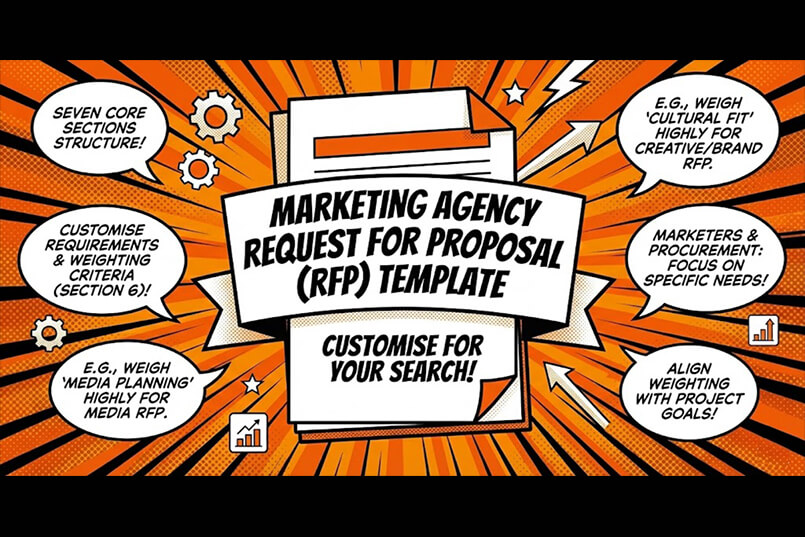
For far too long, the Request for Proposal (RFP) process has been a necessary evil—a bureaucratic exercise often disconnected from true business needs. Marketers and procurement teams frequently reuse generic templates that focus heavily on glossy credentials and superficial compliance, failing to test the critical factors that ensure long-term agency success: strategic rigour, commercial transparency, and operational chemistry.
At TrinityP3, we believe the RFP is your first and most powerful strategic tool. It should force both the client and the prospective agency to focus on the measurable business outcomes you seek.
You can download your free TrinityP3 Marketing Agency RFP Template at the bottom of this article.
Building on our 7-Step Agency Selection Methodology, we have developed a Modular Marketing Agency RFP Template designed to serve as the ultimate starting point for any agency search—whether for creative, media, brand strategy, social media, or PR services.
This template is not a checklist; it’s a strategic framework that ensures every question asked serves the ultimate goal: appointing a partner built for sustained success.
The Core Philosophy: Modularity and Focus
The challenge in writing a universal RFP is accommodating the vastly different requirements of, say, a media planning agency versus a public relations firm. Our solution is a modular, seven-section structure that allows you to activate or deactivate sections and adjust weighting based on the specific search requirements.
The template moves away from lengthy historical descriptions and focuses on four high-impact areas derived from our selection methodology:
- Define Success (Section 1): Focuses the entire process on measurable business outcomes.
- Test for Proof (Sections 3 & 4): Demands real-world evidence of capability and strategic depth.
- Assess Partnership (Section 5): Validates the team structure and cultural fit.
- Demand Transparency (Section 6): Enforces clear, auditable commercial and measurement frameworks.
How to Customise the 7-Section RFP Template
To maximise the effectiveness of this template, clients must approach the customisation phase strategically.
1. Start with the Outcome
Do not start by listing the services you want. Start by articulating the business problem and the Desired Successful Outcome.
Customisation Tip: In Section 1.3, be precise. Instead of saying, “Increase brand awareness,” say, “Increase purchase intent among Gen Z by 10% within 18 months.” This anchors the entire RFP to a measurable, strategic goal (Aligns with Step 1 of the RFP Methodology).
2. Tailor Capability Requirements by Discipline
This is where you make the template discipline-specific.
- For a Creative Agency: Heavily emphasise case studies showcasing breakthrough conceptual work linked to emotional resonance and commercial results. Require specific experience in producing content across diverse platforms (e.g., CTV, vertical video).
- For a Media Agency: Require detail on specific proprietary planning tools, data clean room integration, and independent trading audits. Demand case studies showing quantifiable improvements in Return on Ad Spend (ROAS) or incremental reach.
- For a Brand Agency: Focus the request on methodologies for consumer research, brand architecture development, and internal stakeholder alignment.
- (Aligns with Step 3 Capability of the RFP Methodology)
3. Shift the Focus from “Idea” to “Strategy”
The primary goal of Section 4 is to assess the agency’s brain, not their ability to deliver speculative creative work.
- Customisation Tip: Focus your strategic questions around Question 1 (Articulation of the Core Problem) and require them to state their critical assumption. Do not ask for unsolicited creative concepts. Instead, ask them to outline their approach to solving a hypothetical but real-world strategic blocker related to your challenge. (Aligns with Step 4 Strategic Approach of the RFP Methodology)
4. Validate the Team and Chemistry
The people you hire are not the people who pitch. Use this section to test the partnership dynamic.
- Customisation Tip: When requesting team biographies, insist on the names and CVs of the specific individuals who will service the account day-to-day. Use Question 5 (Conflict Resolution) and Question 6 (Cultural Alignment) to assess their maturity in managing difficult commercial and client relationship issues (Aligns with Step 5 Team and Culture of the RFP Methodology).
5. Enforce Financial and Measurement Discipline
This section ensures transparency before negotiation.
- Customisation Tip: Link Question 7 (Commercial Transparency) directly to the Scope of Work (SOW) document. Require a fully itemised resource plan (names, roles, hours, rates) to justify the total fee. Crucially, require the agency to commit to the specific KPIs outlined in Section 1, transforming the abstract concept of success into an auditable measurement framework (Aligns with Step 6 Commercial Arrangement of the RFP Methodology)
6. Adjust the Evaluation Weights
(Aligns with Step 7 Evaluation Weighting of the RFP Methodology)
The weighting must reflect your priorities.
- If you are hiring a Media Agency where pricing and efficiency are paramount, you might weigh Commercial Transparency at 35%.
- If you are hiring a Creative Agency to redefine your brand where cultural fit is critical, you might increase Team & Chemistry to 35% and reduce the commercial weight.
By using the TrinityP3 Modular Marketing Agency RFP Template and following these strategic customisation guidelines, you move beyond the outdated, speculative pitch and establish a rigorous, outcome-focused process that leads to genuine, value-creating agency partnerships.
Ready to streamline your selection process and appoint the right partner?
You can download and customise the TrinityP3 Marketing Agency RFP Template (.docx) by filling out the form below.